Translate

Showing posts with label Garden-Kitchen. Show all posts

Sunday, 13 September 2015

Gardening in a Greek Village


Gardening in a Greek Village
 Mediterranean Gardening

I have needed to learn about Mediterranean gardening in a couple of previous gardens and with global warming arriving fast even my garden in Melbourne started drying up. I’ve found Mediterranean plants useful Adelaide, and in Lock Sport (a holiday home built on a sand spit). And I came across Trevor Nottle’s book, Gardening in the Sun and Jaqueline Tyrwhitt’s book Making a Garden on a Greek Hillside.

Dream Med. Gardens

There are many books about ‘Dream Med. Gardens’, in France and in Italy. These gardens are often started by British expats, with money, around large houses. There are some who do something similar in Greece. Today for instance the landscape gardener Thomas Dociadis, builds modern stone houses surrounded by the local landscape.

My Med. Garden

It was a dream of mine to have a Med. Garden, and I’ve written before about how my husband and I ‘retired’ and took up the project to renovate his grandfather’s old summer holiday house In Lemnos.

We only have a block of 1200 square meters (300 used by house and outbuildings) When we arrived the land was empty, with a collapsing 100yr old family house in one corner and two ruined outbuildings.

I was much helped by joining the Med. Garden Society and reading their journals, and by obtaining and reading Heidi Gildemeister book about Mediterranean Gardens, including ‘home gardens’.

Hopes and Limits

I wanted to make a practical (and beautiful) garden, within the limits by the island, and the village around us.

What I want to emphasize is that all gardens are different, in situation and location, in climate and soil, and style, even when each is in the Med.

Situation Lemnos


The island of Lemnos is in the Aegean. Our house is a village house; two roads surround it, with other houses behind us and looking down on us, and other houses in front and beside us.

Lemnos:
The island is in the same latitude as Rome and Barcelona
It is an old volcanic island and the 8th largest Greek island. It has few tourists, (Jason’s 1st stopover, and where the Anzaca gathered)

Weather:
Winter winds come from Russia, and include snow; summer winds come from Egypt and are dry. There can be 4 months with no rain
Many centuries of surviving this weather plus fires, goats and sheep have result in typical Mediterranean Maquis  - Survival Vegetation


The hill tops are bare and a few trees in the valleys, e.g. Holm oaks, old mulberry, albizia,
On the hills there is plenty of thyme and oregano, and along roadsides, euphorbia, daisies, hemlock

Planted in my Garden


Found on site
Olive, almond, bitter orange, fig,

Collected from roadsides
Euphorbia, hemlock, daffodil lilies, oleander


Given by neighbours
Honeysuckle, rosemary, bay, Iris, cannas, pampas grass, jasmine, basil, pittosporum, Virginia creeper, lilac, pelargonium, grapes,

Self-seeding 
Fennel, marigolds, pokeweek, zinnias, nasturtiums, alyssum, chamomile, bindweed,

Bought
Pomegranate, pine, box, rose, bougainvillea, citrus, agapanthus, bottlebrush, lantana, gaura, wisteria, yucca, fan palm, agave,


But Basically a Practical Village Garden


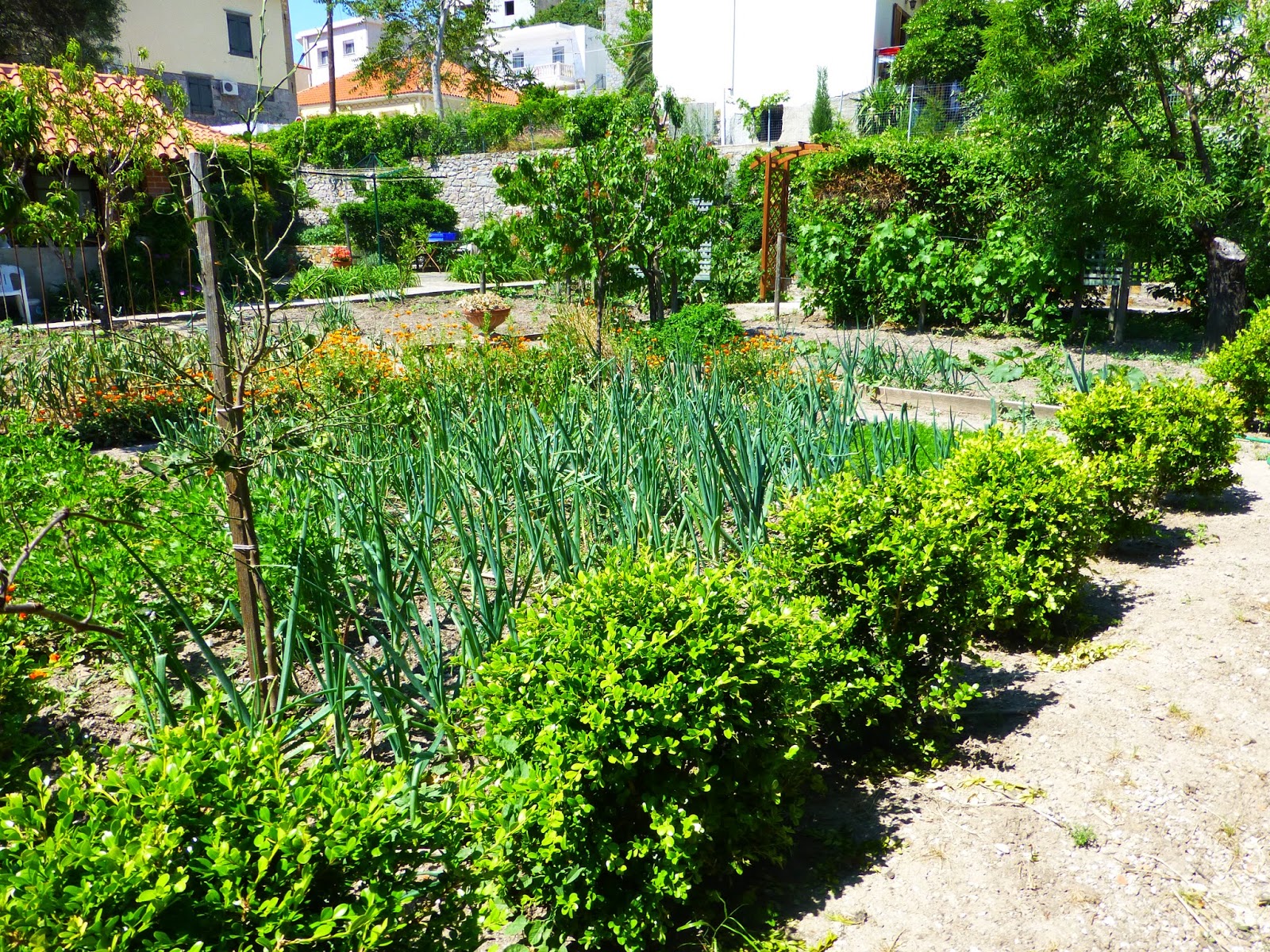
We always harvest beans, onions, garlic, zucchini, peppers, tomoatoes.

Plus a variety of herbs.
And from the fruit trees, oranges, lemons, apricots, figs, and pear, with just a few apples. (I’m encouraging another plum tree, and a mulberry)

Takis makes marmalade from the bitter oranges and I make a lemon and fig jam, plus when we harvest buckets full of peppers and tomatoes and onions I make jars and jars of sauce. All very useful to feed our many guests.

Postscript

Difficulties.
Losing plants because of heat, and cold.
Plus sudden unexplained losses.
Working with Anestis using sign language!
Not being there full time in time to sow seeds or to care for the newly planted.

Wednesday, 13 May 2015

May Growth in our Kitchen Garden


May Growth in our Kitchen Garden


The garden soon after we arrived

The cherry tree when we arrived, just over 3 weeks ago
The cherry tree today


Help! We have had two storms that have watered the garden and now that it is really beginning to warm up everything is growing fast and rushing to seed. Nice to see the roses and marigolds blooming, but not so good to see the onions and beets going to seed so soon.


But, its nice to have food from the garden and since we arrived we have been using something out of our kitchen garden practically every day.

The list of harvesting this month includes:

Beets, Celery, Lettuce, Strawberries, Onions and Mint

Beets

Marigolds, onions and beets

I’ve begun picking the beets and I must pick more soon as while some are very good, but others have already shot up and the bulb has become fibrous inside. Beets need to be trimmed top and bottom, but not too close to the bulb as it will bleed when boiled. After boiling you can easily slip of the skins and then they keep well if sliced in vinegar. They are also good grated raw in a salad. Use the leaves for horta, see below.

Celery


The celery is growing well, but again it will shoot before long with this warmer weather. Here they are not forced to grow tall and juicy but used more often as flavoring, though we use a quantity in a dish the Greeks love, pork with celery. I believe I’ve already posted this recipe. It is very like the Lamb Fricassee, see below, but with pork instead of lamb, and celery instead of lettuce. Both recipes add the lemon sauce to thicken the meat in the last part of the cooking.

Lettuce

The lettuce is wonderful at the moment, green and crisp. We are having salad nearly every day, but I’m also using the older plants in horta. It’s good with a mix of other leaves from the garden such as the leaves of the beets and spinach and endive which I’m buying from the grocer.

Strawberries


The strawberries come from a few plants Anestis supplied us with a few years ago. They were planted in the wrong spot but now I’m looking after them and watering them when the ground dries out. They are a smaller variety than you buy in the shops, and the snails love them. To try to beat the snails I’ve surrounded the plants with pine needles (straw is hard to come by on the island.) I’d love to make a strawberry desert with egg whites, sugar and crushed strawberries, but now that I can’t take sugar I just stew the washed strawberries with fructose and Takis adds it to ice-cream and I add pure cream.

(I might make a pie using almonds in the crust, and filled with ricotta topped with fresh strawberries. That would be OK for a diabetic too.)

Onions


The onions are young and fresh and good in a salad, as long as you don’t mid the aftertaste and your partner has the same salad! Takis used these onions and their tops in place of leeks in his lamb fricassee.

Lamb Fricassee


Takis found some New Zealand lamb which was quite tender, using 1500grs. But even this he boiled first to get rid of the strong lamb flavor. He sauted the onions, use about 4 spring onions and 1 cup of olive oil in a large pan and  then added the chopped meat.

We picked about five large and older lettuce, washed them well and then roughly chopped them. After cooking the meat with 4 tablespoons of chopped dill and 1 cup of water until soft, the lettuces are added for a further 30 minutes.  

Meanwhile two eggs are beaten with 4-5 tablespoons of lemon juice and 1 teaspoon of. cornflour. The egg and lemon sauce is poured over the meat and stirred in and cooked for a minute to thicken.

The amounts give above are for one meal, but being a food producer in his previous live Takis always makes an abundance and we freeze up for later meals. In the case of the pork and celery and lamb and lettuce we omit the lemon sauce, adding when it is defrosted and warmed up to serve.


And, one more gift from the garden.

I’ve begun collecting rose petals to make a pot pourri. My friend Helen does this very well and I’m using her idea of after gathering roses for the house, gradually collecting and adding to the petals in a bowl or basked. Later, when the lavender is blooming I might add these in too. An open bowl in a room is so pleasant to run your hands through when passing, to let out a little more of their fragrance.
The deep red roses have the best scent

Monday, 22 September 2014

Autumn Conserves

Autumn Conserves


A few blogs ago I wrote a blog about late summer and the need to continue conserving ones energy. I think the title misled some readers who though it was going to be about preserving food. The problem is late summer is still very hot. There is hardly anything in the garden. But come the first rains, usually in September, plants plump up and you do find a few things you can put away in jars.

Our zuccini survived the summer, and is now flowering and fruiting again.

Weather

We’ve had two earthquakes - one was 6.8 the last 5.4. We’ve also had some spectacular storms. This year we had an early autumn storm with lots of rain. Wonderful for the garden! My capsicums that had just been hanging on with daily watering perked up and now we have good sized fruit, similarly the hot peppers are growing big and plump.

BUT this rain was also wonderful for the weeds, we have succulent purslane everywhere (Portulaca oleracea - also known as verdolaga, pigweed, little hogweed) thick and juicy. I have not tried eating it but I believe you can. It is supposed to add a wonderful crunch to salads and even sandwiches. Click around for recipes for purslane-yogurt-cucumber salad, Turkish purslane and lamb stew,purslane pilaf, chickpea and purslane salad.


A good rain makes weeding easier

We now have a VERY BIG CROP OF PURSLANE!


Beans and Chili? We try Autumn Mexicana.


The capsicum and hot chile peppers are another plant doing well now we've had rain

Today we had Chili Con Carne. Not very Greek but we enjoyed it. We used the white beans, previously dried, and then soaked and cooked in one of my home bottled tomato sauces. I added a chili from the garden to some chopped fried onions – also from the garden. Mince meat went into this mix, and then after cooking for a while I added the bean and tomato mix to the meat. Into this went chopped olives and a little cumin and curry powder, and the whole was cooked very gently together for an hour. Another bottle of my tomato sauce was doctored with some fried and chopped mushrooms and green capsicums, reduced down, and made into a red sauce. The final touch was a homemade tortilla, then topped with the chili con carne and tomato sauce, grated cheese and chopped lettuce. Yummy Mexicana!
 

Greek Tomato Glyko? Not for me.

I have a couple of problems when it comes to Greek preserves. One is that I’m now a diabetic and can’t tolerate sugar. The other is that I don’t particularly like some Greek preserves.

So though I have just collected the last tomatoes I’m not tempted to make a Greek Glyko with them. This is the Greek equivalent of jam. You will find that many autumn fruits are kept this way; in a heavy syrup, plus a number of other things, anything from baby aubergines, to watermelon rind or baby tomatoes. Nor will I make more sauce with these tomatoes as we already have more bottles than we can use. I think I might be giving some bottles away before we leave Greece for the year. I’ll just keep these last ones in the fridge for salads.

Carrots Sweet or Savory? I’ll try both.


End of year carrots, discovered when weeding

The only other thing recently harvested from the vegetable garden has been a lot of small carrots. We have dug up one now and then during the year, but when weeding I found that a lot were missed. I did water them these plants now and then but they seem to have actually keep better left in the ground, mostly dry so they did not rot. What can I do with a lot of small carrots? I might make a sugarless carrot cake, but most I’ll probably just grate into a salad. Though Takis has his eye on them to make a Greek carrot, potato and artichokes dish (Aginares a la Polita). This also includes lemon juice, spring onions, fennel and olive oil.

Harvest Variability


Almost too many tomatoes this year


But not enough grapes to dry

 
A big crop of apricots this spring


Because weather patterns have been different this year our crops have also varied. We have had a poor grape and almond harvest and almost no olives, maybe because it was a much milder winter than usual. In fact Lemnos has been green nearly all year with a late rain in June and an early rain in September. I’ll miss the almonds, as we usually have buckets full. And everyone has had a bad grape harvest so we are not getting our usual bags of grapes from neighbours who have allotment vines. But we did have a huge apricot harvest earlier in the year, and lots and lots of tomatoes over summer. Plus, I still have olives from the really good crop two years ago!

 Snails? Definitely no!


We are getting a lot of snails, and (don’t tell my granddaughters or Takis daughter Lisa) but I’m going around stamping on huge numbers every day. As I yank up the purslane I find they are hiding under their green cover, just waiting to eat anything planted in the vegetable patch.

However I’m reliably told that snails cooked with onions in tomato sauce and served with rice or flomaria is a good Lemnian dish and is called ‘Saligaria Stiffatho’. In fact my neighbour came late for coffee the other day as she had been preparing just this dish. But, looking at the recipe, below, I can see that to try and cook them is very complicated so I think I’ll give that a miss!

Saligaria Stiffatho


Plenty of snails, but not my idea of a meal

However this is the recipe from Recipes from Limnos. By Ourania G. Vayakou

 To make this dish you first place a bunch of thyme plant in a basket and scatter in the freshly picked snails. Seal the basket with a cloth for 2-3 days. Fill a bowl with water; add 4-5 tablespoons of salt and the snails. Stir snails vigorously and rise. Repeat process in changes of water until snails are clear of any saliva. Now fill a bowl with fresh water, immerse snails and allow them to stand for 30 minutes. This will coax them to poke their heads out. Fill a deep saucepan with water, bring to the boil and add snails. Cook for 5 minutes. Strain snails and remove top cone with a sharp knife. Rinse snails in changes of water until clear of shell bits. Fill deep saucepan with water once more, add snails and cook for 4-5 minutes. Remove and discard froth. Strain snails and set aside.
Sauté onions add tomato and bay leaves, warm water, salt and spices. Simmer for 10 minutes. Add snails and simmer until cooked. Serve hot or cold with rice or flomaria!!
* Flomaria is a Lemnian pasta.

And Questions This Autumn for Next Year?


To think about. Our Albizias are not doing well. Chop them back and plant something else?


And, should we prune our olive tree back hard? We like the shade but they do better with a hard prune now and then

Thursday, 24 July 2014

Tomatoes Galore


Tomatoes Galore


Tomatoes Galore
    
The tomato is the edible, often red, fruit of the nightshade plant Solanum lycopersicum, commonly known as the tomato plant. It originated in the sough American Andes and its use as a food originated in Mexico. It spread throughout the world following the Spanish colonization of the Americas. The tomato is used in many different ways, eaten raw, as a sauce, in salads and as a drink. We tend to think of it as a vegetable even though it is a fruit.

From Wikipedia

‘The word "tomato" comes from the Spanish tomate, which in turn comes from the Nahuatl word tomatotl [aːˈtomatl͡ɬ]. It first appeared in print in 1595. A member of the deadly nightshade family, tomatoes were erroneously thought to be poisonous (although the leaves are) by Europeans who were suspicious of their bright, shiny fruit. Native versions were small, like cherry tomatoes, and most likely yellow rather than red.’

 
One VERY strange tomato, Yes, this really is only one!

‘The Aztecs and other peoples in Mesoamerica used the fruit in their cooking. The exact date of domestication is unknown: by 500 BC, it was already being cultivated in southern Mexico and probably other areas. The Pueblo people are thought to have believed that those who witnessed the ingestion of tomato seeds were blessed with powers of divination. The large, lumpy tomato, a mutation from a smoother, smaller fruit, originated in Mesoamerica, and may be the direct ancestor of some modern cultivated tomatoes.’

The harvest is full on at the moment (24th July)

I’m picking bowls full and making lots and lots of sauces. Some bottles are mostly tomato but with other vegetable and herbs added, or else I’m bottling pure tomato juice.


Sauces and Juice

These sauces are great to add to other vegetables, particularly beans (of all kinds).

You can add them to a vegetable such as aubergines. Cover with sauce then bake with the addition of crumbled feta cheese. 

Or you can use them for the classic tomato sauce dishes, such as Moussaka or Pastikio. The first basically aubergines and potatoes sliced thinly, covered with a minced meat and tomato sauce and topped with bechamel sauce. The second is pasta tubes covered with the meat and tomato sauce and topped with bechaemel. Use the quantity of each ingredient to your (and your family's liking).


Pasta and Tomato Sauce

Tomato and Aubergine - a good dip

Tomatoes and aubergines together make a great dip.
My fast way of doing this (without roasting the aubergines first) is to fry a lot of onions and a lot of garlic. The add tomatoes that are chopped and seeded. The sliced aubergines, and cook it all up together. Cool the mixture and the blend. Add salt and pepper. Serve with some crumbled feta over the top.


You can also have tomatoes in everything, in the salad, in the sauce and in the pasta filling!!!

The ubiquitous Greek Salad!

A recipe from Recipes From Lemnos by Ourania Vayakou

Peasant’s Salad (Choriatiki Salata) 

4 ripe tomatoes, skinned and coarsely cut
2 cucumbers, sliced
2 green peppers, seeded and chopped
I big onion, coarsely sliced
Olives
Feta cheese
Dried Oregano or fresh parsley finely chopped
Salt
½ cup of olive oil
 Rinse and chop vegetables, sprinkle with salt and toss. Turn into bowl and top with small cubes of feta cheese and olives. Garnish with olive oil and dried oregano or fresh parsley.
 (A friend of mine swears that he and his wife never get winter colds as they have this salad at least three times a week!)
 (And I nearly forgot to put the most important hint from Ourania. 'This is a very popular mixed vegetable sald, best in summer when the weather is warm and vegetables grow in the open air, under the hot sun.'!!!)
 

And this is Not Just Tomato Harvest Time


Our beans have now dried on the bush and here we are collecting a bowl of dried beans.


And at the same time we are dealing with a crop of pears

Sunday, 20 July 2014

Slow Food and Guests


Slow Food and Guests


We've just had a fun day with guests making ravioli. A morning making and a slow lunch eating!


No, to ‘Fast-Food’


There is something insidious about ‘fast-food’ as against quick home made meals. These outlets tend to rely on formulas that please (sugar-fat-flour), often so much so that to indulge is to the detriment of our health.

We spend half the year in a beautiful wooded area of Victoria, and until last year McDonald’s did not have a foothold there. But in spite of much lobbying by the locals the government eventually allowed one to open. Of course there are many who say they want fast food, and do go to this shop, but as with many of these fast food distributors this is not seen as a one off enterprise they can only exist by growing FAST (notice the ‘s at the end of the name). That means they will have their sights on other small villages in the area.


(ps. I once went to a McDonald’s and my critique of that meal was that the burger was flat and soggy pancake, nothing like the picture high juicy burger pictured behind the counter.)


Yes to ‘Slow-Food’


Of course we all like and sometimes need to have a quick snack or a quick meal, but we can do that for ourselves, with a lot of fun, and a little effort. One batch of homus will keep a few days to have with various raw vegetable or dry bread as a dip (If you want a quick recipe use tinned chick peas, but they are better if you cook them yourself, however that does take longer.)


Takis loves making homus and we love eating it!


a)      You can regularly cook in bulk and then cook or freeze portions for another day.


cooking in bulk, two pans in the oven, serving 6 for two meals


And then as an extra (slow food) bonus we cooked the vegetables and fish in the furno

While we had the furno going our guest offered to make bread for us

b)      You can have a fun day cooking up something a bit tricky but delicious with friends.


Making dolmades with a guest. A long slow process, best done with a friend


c)      You can watch a crop growing, and even though by the time you pick those items are cheaper in the shops, you can bottle, freeze and cook up something really special. Something unique that you can’t buy in the shops!


Our first harvest this year was apricots. Takis jam making

d)     And even if you don’t have a garden you can buy up at those times when the crops are coming in fast and grocers are selling cheaply, by the boxful, and then do the above!


OK local Lemnian bread is very good, and cheap, but what can compete with the joy of home made bread? The best!


Slow Food International


This is an organization with branches in over 160 countries. . It is a global, grassroots organization linking the pleasure of good food with a commitment to local communities and the environment.


There is an international network and activities around the world. It was founded in 1989 by Carlo Petrini and a group of activist. They aimed to prevent the disappearance of local food cultures and traditions, and to counter the rise of fast life and fast-food.


I don’t belong, as yet, to this organization but I realize that our philosophy (Takis and I) agrees with this approach to growing and eating locally. It also suits our lifestyle here in Greece where we love to share food preparation with our guests.


Slow Food and Guests


making tagliateli


Getting ready to make ravioli


By the time we finished we were a well organized production team!