Translate

Saturday, 8 February 2014

Cooks and their Recipes


Cooks and their Recipes

Traditional Lemian Foods

Wheat has always been an important crop in Lemnos, the tiered hillsides and many ruined windmills testify to this industry. Lemnos became an important granary for the Athens and in later times much wheat was sent from the island to Constantinople. Lemnos has also long produced thyme honey, plus an ewe’s milk cheese, known in Greece as kalathaki, meaning ‘small basket’ as it is formed in a small wicker basket. There is also the wine that Homer referred to when he wrote about Agamemnon reprimanding his soldiers for their laziness and wine drinking, ‘Once while in Lemnos…drinking wine in overflowing glasses.’
While in Lemnos, we make a special effort to buy local cheeses, wine and honey, all foods we can’t easily buy back in Melbourne. I could wax lyrical about the meli, the thyme honey that comes from the beehives up on the hills near the island villages. This is one of the greatest pleasures for Takis and me that we are able to prepare and sample some of the same meals that Lemnians have enjoyed for generations.

Krasse (Wine)


The wine produced in Lemnos is now well known throughout Greece and is even sold overseas. It was well known to the ancients. Homer refers to Lemnian wine twice in the Iliad. The first time is when King Agamemnon chastises his men: ‘What has happened to your boasting that we were the best,/ As you used to say once while in Lemnos – big empty words – told/ with abundance of beef from horn bearing oxen on the table in front of you/ and while drinking sweet wine in overflowing glasses...’
The next time the poem also mentions Queen Hypsipyle and Jason: ‘And they had wine from Lemnos carried by/ numerous ships and sent by Evino,/ King Jason’s son born to him by Queen Hypsipyle.’

Today a white wine is made from Moscato Alexandrias, a variety of grape brought back by Greeks from Alexandria. This is one example of how the Alexandrian Diaspora benefited the island. (However, another plant imported from Egypt, cotton, was a disaster.) The white wine produced on the island, as mention earlier, is interestingly named after the ‘holy earth’, Lemian Yea. There’s also a red wine called Kalambaki. The more famous Greek liquor, ouzo, is made out of the skins of the grapes after the wine is taken and is flavoured with aniseed. Many local farmers make their own wine and ouzo.

Psomi (Bread)
Nearly every day Takis drove down to the bakery to buy us a couple of loaves from the bakery, which we ate while still warm for breakfast. We loved having fresh bread some days, but what was left we sliced and froze to be used the next day.

In the past the Lemnian women baked once a week in the traditional wood-fired ovens. As Ourania wrote, ‘By tradition, they made their own live yeast from the holy water and basil plant the parish priest handed out on the 14th September, when the Orthodox Church honours The Holy Cross.’

The baked bread had to last for a week; to ensure this the women placed the loaves on a long plank called a Kania, suspended by a rope from the beams of the ceiling, ‘thus keeping bread out of the reach of both mice and hungry children!’

Pitta (Pastry), and Zymarika (Pasta) 
There was once extensive cultivation of wheat on the island, mostly in the valleys but also up on terraced hillsides so steep that only cattle-drawn ploughs could work them. Production today is mechanized and occurs only in the valleys. The old windmills are now abandoned; however, you can still buy Lemnian flour in the island’s supermarkets - a hard, yellowish, wheat flour that makes great pancakes. Because of the abundance of flour down the centuries, though most of the recipes developed were very simple, the island women found a variety of ways to make pastas and pastries.

The most common pastry used in Greek cookery is phyllo, made out of flour, oil, water and salt rolled out into tissue-thin sheets. Tyropittas are cheese pastries, and spanakopittas are spinach and cheese pastries. Today Takis and I tend to use shop-bought frozen Phyllo or short crust pastry for these savoury pies, and we elaborate on the simple fillings, using leeks with the spinach and at least three cheeses in our tyropittas.

Phyllo is also used for Glyko (Sweets). Baklava is a well-known Greek sweet made out of layers of Phyllo and walnuts and syrup. Another pastry that I love (and the sweet Takis had made to tempt me into this project) is galaktoboureko (custard tart). This is like the custard tart made in many countries but in Greece it is made with Phyllo and the final confection is covered with syrup. Bougatsa is yet another variation of the custard tart, but simpler, with less custard and no syrup. Bougatsa is the sweet we regularly buy when we go to the Agora to have our morning coffee.

                                           Baklava


While these pies and sweets are found all over Greece, it is the ways in which pasta is made that are unique to the island. Flomaria is a soft type of spaghetti made with Lemnian wheat, sheep’s milk and eggs. Trahanos is made with sour milk, and is used in soups. Both are sold in the island’s supermarkets.

Tyri (Cheese)
A soft white cheese is made out of ewe or goat’s milk, just as it was centuries ago. It is still formed in small basket shapes. Originally the curds were placed in small round baskets made of reeds to drain, and this is why the cheese is known as kalathaki (Little baskets). There are a number of varieties of this cheese. One, called melihloro, is harder and saltier and is grated over spaghetti.

Kreas (Meat)
One year my English cousin was visiting us and Vetta invited the two of us to go with her to see her old home in the hills behind our house. It was a mild September day and a beautiful walk through the hills, though they were still dry, as the rains had not yet come. We walked to a little stone hut high on a hillside, where Vetta, her two sisters and brother had been raised. Nowadays the sheep only uses the structure, but then her mother grew flowers and basil in the small forecourt.

Behind the hut was another structure that I was very interested in, as there were three little pigs housed there. Every week I had to save any stale bread for Vetta, and she then passed this on, with any vegetable peelings, to her brother to feed to his pigs. It was fun to see these happy and inquisitive porkers, though a bit worrying to know that they were being fattened up for New Year chops.

Today, as in the past, farmers keep their pigs for a year and traditionally slaughter them the day after Christmas, a timing that enables the family to feast on fresh steaks during their New Year celebrations. Every part of the pig is prepared for later consumption. The meat is salted and fried in its own fat, then preserved in big earthenware pots and is called kavurmas. The fat is cut into small strips and preserved in the same way. The intestines are filled with minced meat to make sausages. In the past even the bones were salted and later used in stews, with pulses, potatoes and vegetables, the head was used to make pork jelly. In the past even the skin was dried to make the farmer’s shoes.

Takis’s Savoury Greek Dishes

Nose, nose, jolly red nose,
And who gave thee this jolly red nose?
Nutmegs and ginger, cinnamon and cloves,
And they gave me this jolly red nose.

Beaumont and Fletcher


           Takis and a neighbour making pasta 

Traditional dishes in Greece tend to emphasise a national pride in a particular herb for a particular dish. You will be told, emphatically, ‘This is how such-and-such should be cooked.’

But then, there are other cooks less nationalistically minded, who are willing to experiment, perhaps using herbs as they are used in other countries. This last group includes Takis and me. We have a European bias but we also love the Asian foods we’ve eaten in Australia and Singapore. I often tease Takis that he has an extraordinary nose, as he is able to pinpoint exactly the flavouring in a dish. And Takis and I after a meal often try to analyse the tastes of whatever we have eaten, to ascertain whether we would change anything next time.

Pork and Celary Avgolemono


salt and pepper
half a cup of olive oil
1 leek sliced in small rings
1 onion finely chopped
1 cup  white dry wine
1 whole bunch of celery cut (stems and leaves) into 4 inch lengths
2 eggs
1 teaspoon cornflower
juice of 2 lemons

Fry the meat in oil in a heavy bottomed casserole, a few at a time (to keep the casserole temperature high)when the juices are sealed (brown the meat) remove and set aside.
In the same casserole fry the the onions and leek ( in the left oil) till soft.
Add the wine and cook until the wine is reduced to half.
Return the meat and add 2 glasses of water, add salt and pepper, cover and  simmer for 40 minutes.
Add the celery and continue cooking a further 15 minutes.
In separate bowl beat the eggs with the cornflower.
Take a cup of warm cooking juice out of the casserole and gently incorporate into the egg mixture whilst stirring constantly, add the lemon juice.
Pour the mixture into the casserole and stir uniformly to spread around.
Increase the heat until the sauce is thickened, do not boil.

Plain rice goes very well with this meal.

Koula, A Geek Queen of Cakes


Koula on her home island of Rhodes


Koola is a classic beauty. Still in old age her long grey hair was caught up in a neat chigon. She has many friends, and daily chatters to them by phone, checking up on their and their relative’s health. While staying with us, George and Koola would sit on the terrace listening to the Greek new broadcasts, and when she received one of her many return phone calls he would quietly play with his komboloi.

Koola is also excellent cook, having added to her knowledge of Greek from her life in Alexandria and stays in France. She makes wonderful baklava, sweet loukoumades, divine galatabouriko, and all sorts of gateaux and ice-cream dishes. I was always happy to hand over the daily meals to her, while I concentrated on harvesting and preserving.


                                        Loukoumades

Though it may be friendly sparring at first, Koola often challenges Takis, as to who can cook the best pastichio or mousaka. This can sometimes get him stirred up enough to compete at the next meal with another masterpiece. And, interestingly, when it come to washing up both rush to take over, believing that each can also do that job better than the other. But again this does not worry me, as it is another time when I’m not averse to handing over the kitchen to others!


Meanwhile George, who sits most of the day on the terrace, listening to his radio and playing with his Komboli, promots his wife’s cooking at every opportunity. He looks with great suspicion at anything he is not familiar with, like Takis’ Thai Chickeni, or my Bread and Butter Pudding!

Fanouropita (A Traditional Cake)

                                  Saint Fanourios


Here’s a story that involves Lost and Found, a Saint, a Sinner and a Cake. Say you’ve lost something or someone. Who are you going to call?  Did you know there’s a traditional Greek Cake For Lost Things called Fanouropita?

                  Fanuropita Cake


It’s dedicated to Saint Fanourios who is the one you call upon for help when you need to find something. This cake is traditionally made on the eve of Saint Fanourios’ Name Day every year, on August 27. The cake is brought to the church of Saint Fanourios where the priest blesses it during a special ceremony. Afterwards, the cake is cut and everyone shares.


It seems that the saint’s mother was a mean so-and-so and did not share easily, but the saint did, and said that other’s should bake the cake, and share it, while asking for God’s forgiveness for his mother’s sins.

This cake is suitable for those fasting for Lent in preparation for Easter due to the recipe having no eggs, milk or butter. Also note that traditionally the cake is made with only 7 ingredients. But it can be made anytime something is lost. This year a neighbour came to our door with a plate with several pieces of a Fanouropita. The problem? They had just lost her husbands wallet! Next time I saw her, thanks to St. Fanourios, they had found it!

7 Ingredients - Serves 8

1 cup extra virgin olive oil

1¼ cups fresh orange juice

2 teaspoons cinnamon
1 cup sugar

3 cups self-raising flour

1 cup walnuts, finely chopped
1 teaspoon baking powder

(100 grams of icing sugar for dusting  - optional)

Method
Preheat the oven to 160°C.
Place the olive oil, orange juice, cinnamon and sugar in a bowl and mix well with a wooden spoon until the sugar dissolves a little.
Add the flour slowly while continuing to mix well. Then add the walnuts, followed by the baking powder. Continue stirring until the mixture is well combined.

Turn the cake mix out onto a round baking tray lined with greaseproof paper and bake in the oven for 15 minutes. Then reduce the temperature to 130°C and bake for 30 minutes or until cooked. The cake is cooked when a knife inserted into the centre emerges moist but with no mixture sticking to it.

I left my recipe book with Koula’s recipes in Lemnos, so this one is with thanks to the following site.

http://cakeappreciationsociety.com/lost-something-make-a-fanouropita-cake/

see also

http://www.iliasthegreek.com.au/

Thursday, 6 February 2014

My Lemnian Herb Garden


 My Lemnian Herb Garden

Early days 


Elizabeth David wrote in French Country Cooking that dried herbs should be bought in very small quantities and stored in air-tight jars as they quickly loose their flavour.  She goes on,

‘People who seriously intend to have good cooking grow as many kitchen herbs as they can, so as to have them always fresh’.

Fresh vegetables hold centre stage in the Greek kitchen. These are then transformed by olive oil and spices into wonderful dishes.

My Lemnian Herb Garden is close to the kitchen so I can easily go out to gather the herbs I’ll need for a meal. The paving around the herb garden, though basically made with too much cement, does add to the heat and dryness that most Mediterranean herbs love.


Anestis, our garden and house helper, does a tidy up before we arrive on the island each spring but after my arrival I also need to do some pretty serious chopping back. I clip the bay tree to the lolly-pop shape I want, and rip out the spreading mint. I often still have jet lag, and find our Lemian tools less than sharp – in fact the handles of our sheers have to be regularly thumped to get them back on! However, a day or two later, with more help from Anestis the herb garden begins again to look cared for and full of potential.

A Mix of Flowers and Herbs

My herb garden is more than just beds for herbs as I also use the beds for flowers. There are marigolds and nasturtiums there early in the year – both edible. In July the zinnias begin to bloom, and much later chrysanthemums will be giving autumn colour. These last two are pretty but not edible. This is also the area where I plant Lavender bushes.


Lavender (Levanda)

Old English song.

Lavender blue dilly dilly, lavender green
When I am king dilly dilly, you shall be queen.
Some to the plough dilly dilly, some to the ?
While you and I dilly dilly, keep ourselves warm.

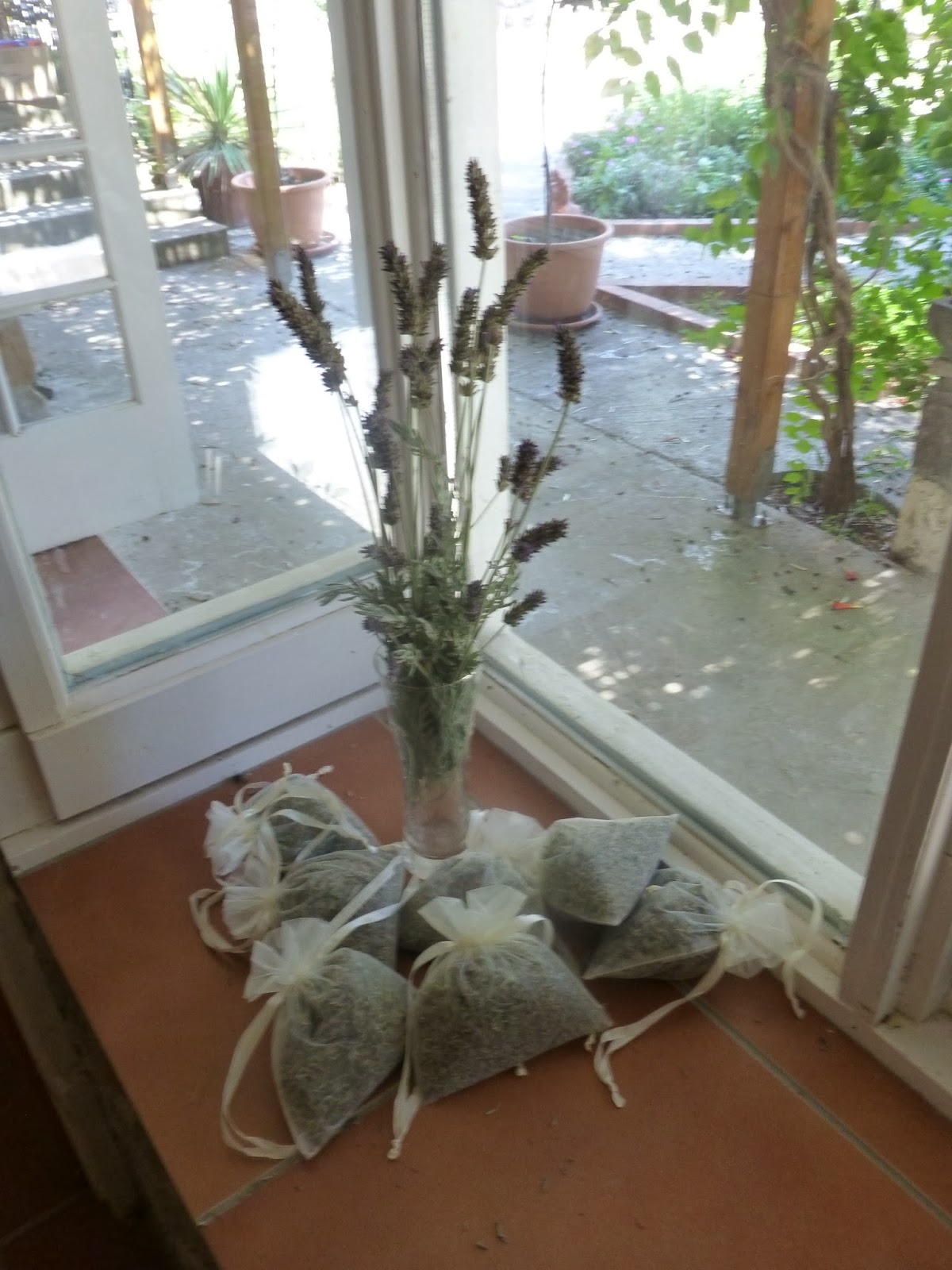
Lavender has a long history and has always been extensively used as a perfume. The Greeks and Romans used it for their baths and in later times it was placed in the folds of linen to repel moths before the linen was put away. Beside bags of lavender the dried seeds can also be used in a pot pourri. The harvesting of blooms should be carried out in dry weather. It is so warm in Greece you can do this in June rather than in August as recommended for Britain. I tie the stems in small bundles and suspend head downwards to dry in our garden shed. The flowers also make useful cut flowers.

In Lemnos I buy small net bags from a Wedding Shop for the lavender.


There are many types of lavender. What I’ve know as the ‘Spanish’ has deep purple bracts, and as the ‘English’ has long pointed leaves and flowers born on long elegant stems, and the ‘French’ has toothed fern-like leaves and smaller dense spiked flowers. I’ve found the ‘English’ best for drying and making up into bags and pot pourri. The only ‘English’ plant I had grew large and I used in to make many scented bags, but it only lasted a couple of years. I think the winter snows killed it off, and I’ve never found another in the island nurseries. However the toothed, fern-leafed lavender has proved hardy. It tolerates coastal conditions and even short periods of dryness once established and I’ve found the toothed lavender leaves are almost as scented as its flowers. 


 In Australia I make my lavender 'bags' from a collection of old print handkerchiefs


Some Essential Herbs for Cooking


Many herbs grow wild in the Greek hills. Thyme and Oregano are graze-resistant and are also able to survive up on the dry hot hillsides of the island. The plants from the hills have a more intense flavour as the heat and poor soil intensifies the concentration of their natural oils. In early autumn Anestis goes up to the hills and picks some Oregano, Rigani, and after we have hung it for week (in the garden shed) I strip off the dried leaves and flowers which I then put in bottles to save for the next year.

Oregano

 
But I also have thyme (regular and lemon scented), and oregano in my herb beds, plus a clipped bay tree and rosemary bushes.


                                  Thyme 


Rosemary (Dendrolivano)

Rosemary is a small Mediterranean shrub, quick and easy to grow from cuttings, and easy to care for. It has needle-shaped leaves and mauve-blue flowers. It has also survived in the wild as it is another graze-resistant herb. 

Rosemary has a slight taste of camphor and its sharpness is valued as a seasoning for lamb and kid, while dried Rosemary is used to flavour sausages. I like to push it into flaps on a leg of lamb, together with cloves of garlic. It gives a wonderful rich taste to the lamb and to the gravy made with the juices. You can easily remove the sprigs before serving. 

Wherever Rosemary is grown it benefits from regular pruning, to prevent it becoming woody and it looks great as neatly shaped low hedge. There is also a prostrate variety which looks wonderful growing over the edge of a stone wall.   

 Mint (Yosmos)

I’ve found out that ‘mint’ is the name given to a quite different plant on the island. What I know as mint in Greek is called Yosmos. It is included in quite a number of dishes. Vetta, my neighbour, often comes in the morning to gather a bunch of fresh mint from our garden for the meatballs she is about to prepare. Mint has a fresh clean taste that enhances delicate fresh flavours.

This herb is also used a lot in the Middle East. It is put in salads and traditionally in purees of dried legumes and vegetables. It is also used in a sweet tea served at the end of a meal. In Greece I add mint to befteki (meat balls) and to dolmades (stuffed vine leaves). Though I still sometimes use mint to make an‘English’ mint sauce with vinegar. I also use a spring of mint with our new potatoes, remembering meals I had in my youth.

I keep this plant in a separate bed as it quickly spreads, and also needs more water than the other herbs.

 Parsley (Mydinos)


Parsley, mydinos in Greek, is a plant much used in Greek cooking. It also needs plenty of water to get it through the summer, and like the patch of mint it is watched over not only by us but also by Vetta who often comes in to get a sprig or two for one of her recipes. She adds it to a white bean dish, and to her meat sauces.

Bay (Daphni)


The Greek name for Bay is Daphni, which is a word that offers a quite different picture in the minds of those who expect ‘daphne’ to be a low scented bush. In Greece the name of this plant comes from the story of a nymph pursued by Apollo who, desperate to escape, asked Gaia for help. The Earth Goddess then turned her into this shrub. In remembrance the saddened Apollo picked some leaves and formed them into a crown for his head, and ever after Greek athletes have been adorned with a ceremonial crown of bay leaves.

As a vegetarian for much of my life I found that most vegetarian recipes began, ‘take an onion’, but after that I found that bay was the herb that gave the most ‘meaty’ flavour to vegetarian stews and soups. It can be used fresh or dried. Nowadays when I sure I add two or three bay leaves to long-cooked meat dishes - making sure I remove them at the end of the cooking. Bay is also one of the classic herbs used in a bouquet garni. A leaf can even be added to a milk pudding.

Caper (Kapari)

When we first arrived at the house there was a large capparis plant growing out of the old wall along the front of the house. I’d like to say this survived however it just could not cope with all the human interference that occurred when we rebuilt the wall. I would have loved to have kept this plant, as it evidently was known in the neighbourhood – Vetta informed me that its flowers were beautiful in springtime. I did try to save some roots and grow it again in a crack in the new wall but I knew I was being optimistic and it was unlikely to take.

It appears that this is one of those wild plants that do not take well to cultivation though it is often found in Greece on old rocky sites. It is an old plant, appreciated by both Romans and Greeks, who used the preserved flower buds in their cooking. The flowers buds were gathered and preserved in vinegar or salt. Today I tend to gather nasturtium seeds as an alternative and preserve them first in salt, and then in vinegar.

Basil

This is a herb that does not survive the winter and needs to be replanted each year. I always have a couple of pots of it on the terrace. If I don’t Vetta will soon bring me seedlings. We use basil to make pesto, a more Italian than Greek dish. Though we tend to use almonds instead of pine nuts as we’ve usually got a lot of stored shelled almonds. We like this pesto over a mix of bowtie-pasta and chickpeas rather than all pasta.

Basil is much used in church ceremonials in Greece; bunches of basil are used by the priest to sprinkle holy water on the congregation. And it has a number of mythological stories that connect to this plant. One I was told by my sister in law was that it was unlucky to have a basil plant in your home. At least it is unlucky for your husband and ‘basil’ means ‘the lord’, and there should only be one lord of the household, thus to have a pot of it is a threat to your husband!

Fennel

Originating in Southern Europe and Western Asia this is an erect perennial herb that can grow to 2.5 metres. The Greek name marainome (to grow thinner) comes from the time when the ancients used Fennel to suppress hunger pangs. Its fern-like leave smell of aniseed as does its seeds. It has small flat umbels of yellow flowers in late spring. I’ve read that is not a good idea to plant Fennel near to Dill or Coriander as it may cross-pollinate and alter the flavour of the other two.

I saw so many wild fennel plants on the roadsides in the island that I dearly wanted one or two in my garden, to be able to use their leaves like dill in potato or fish dishes. Like many other herbs Fennel too can be an invader growing in disturbed roadside soils, along waterways and drainage lines. The variety known as Florence Fennel has a swollen stem base and it is frequently used in Italian cooking.

          The Herb Garden in Autumn

Two of my favourite cook books

One of my favourite food writers is Elizabeth David.  I took several of her books with me to Greece. One was Summer Cooking, and another was French Country Cooking, both old penguin handbooks, quaintly illustrated by Adrian Daintry.

Elizabeth David introduced post war Britain to Mediterranean cooking. She wrote so skillfully that the delights of what she had seen and tasted on her travels came into the kitchen with her books.  I have feasted on most of her books and chose this one to take to the island as it is all about summer holiday cooking,

‘Food cooked in an unfamiliar kitchen... a temporary Paradise... situated close to a Mediterranean shore’. She describes shopping for ‘sweet ripe tomatoes, mild onions, olives and cheese’. And after describing her purchases for a ‘car-borne summer picnic’ she concludes, ‘You are on holiday. You are in the company of your own choosing. The air is clean. You can smell the wild fennel, thyme, dry resinous pine needles and the sea. For my part, I ask no greater luxury. Indeed I can think of none.’

Some garden web-sites I've enjoyed

fruit and vegetables

cut flowers

Greek garden ideas


Wednesday, 5 February 2014

Garden Magic


Garden Magic!

Gardens are magic places.


A story from my childhood.

‘My Grandmother’s house was a tall, three story high, old Victorian, brick house on the edge of a old aging brick built town, on the outskirts of London. It was surrounded, as one might guess, by tall dark laurel bushes, planted between tall dark pines. But the garden was not all shade and darkness, as in the center was a wide-open patch of grass that was a tennis court. And to one side was the vegetable garden. And beyond a tall hedge was an orchard, where my aunt kept her rabbits.

It was a place of abundance after my house in London, where I lived with my mother, Grandmother and two aunts. In that house I had to sleep in the same room as my mother. There were no wide corridors, and only a very narrow steep staircase, that I had once fallen down, that lead to the three upstairs rooms. There one could hear what the neighbours were playing on their record player, and when they came to blows after drinking at night. But here, though I sometimes got bored by myself all day, I could wander and dream. I could even find someone to talk to if the gardener had finished digging up the carrots, and was sitting in his shed for his elevenses.

I would prop up the door and ask him if he had seen any wild rabbits in his garden. I had just read Peter Rabbit and I knew that rabbits did not ordinarily live in hutches, like my aunt’s, but with their mother, under the roots of an old tree. And that they loved going into vegetable gardens to nibble on things they found for themselves.

Just then I saw a mouse run across the window of the shed. However the mouse was running on his hind legs, and was dressed in a green velvet suit!  I did not think that the gardener would believe me if I told him what I had just seen, but I did ask him if he’d seen any mice recently. He said,
‘The varmint. They make a mess in this shed every night.’
I wondered if maybe Grandmother would believe me if I told her about the mouse wearing green velvet, after all she had read the story to me last night. Would she have time to listen?

So I let the gardener eat his current bun in peace, and went in through the back door into the kitchen. Here Grandma sat with Winnie her maid having their elevenses.

            ‘Come in dear and have a drink of milk. I’ll warm it up for you. Would you like some current bun too? It has pink icing on it.’
‘She was following me around all morning.’ Winnie complained.
            ‘Who is She’ reproved my grandmother. ‘You should call her Miss Julia’.
            ‘Miss Julia, then, she’s always asking questions.’
            ‘Its good for children to enquire. It shows intelligence.’ Grandma replied.
‘But darling’ she said turning to me, ‘You must not stop Winnie when she is working.’

By this time I had my milk and bun in front of me, and decided not to trouble them with mice walking on their hind legs, dressed in green velvet.


Later I was living with another set of grandparents. And again was intrigued by the garden shed. Here my grandfather polished our shoes, here he had a pot of glue with which he mended all kinds of broken things, from chairs to toys. The glue he told me was made from the hoofs of old horse - a thought that both intrigued and horrified me. In another yet another garden shed this grandfather had rows of apples on trays, to be kept for winter treats.


When I was thinking of garden shed I thought there must be a poem about garden shed but though I checked I could not find one, so I wrote this one.


The Garden Shed by Julia Catton

In a garden office
A precious hoard
Of sharpened implements
Are carefully stored.
Wheelbarrows, flowers pots
Are the gardener’s tools;
Horticultural equipment
Not used by fools.
String and posts
Trowel and hoe
For clever hands
Not any Joe.
Tom, Dick and Harry
Jane, Julie and Jill
Might dream of a garden
But it needs skill
And the will to work,
With rake and saw,
Clippers and spade -
And often more.
Until finally when
The seeds grow green
The gardener’ll discover
The image and dream.


And thinking about wheelbarrows here is a poem I did find, about wheelbarrows.

Wheelbarrow  by Eleanor Farjeon

He dumped her in the wheelbarrow
And trundled her away!
How he chaffed and how she laughed
On their wedding-day!

He bumped her through the garden-gate,
He bounced her down the lane!
The he reeled and then she squealed,
And off they bounced again.

He jiggled her across the ditch
He jobbled her through the holt!
He stubbed his toe and she cried O!
Whenever she got a jolt.

He wiggled her up the bridle-path,
He boggled her through the street –
Down he stumbled! Down she tumbled,
Right at the parson’s feet!


Garden sheds must catch their magic from gardens, for if you think about it wonderful things happen in gardens. Here there is silence while magic sleeps, and then with a rush in spring everything comes alive. Here those empty spaces where dry brown bulbs lie turn into beautiful beds of red tulips and yellow daffodils. And think of those small dry specks of seeds that you pushed into the ground that in a few months put on large leafy displays.


God’s Acre by Christina Rossetti

Hail. Garden of confident hope!
Where sweet seeds are quickening in darkness and cold’
For how sweet and how young will they be
When they pierce thro’ the mould,
Balm, myrtle, and heliotrope
There watch and there wait out of sight for their sun’
While the Sun, which they see not, doth see
Each and all one by one.