Translate

Showing posts with label Diaspora Dilemmas. Show all posts

Saturday, 10 October 2015

Migrants All, from Way Back


Migrants All, from Way Back
 

Today’s Big Problem for Europe


In the papers here this weekend there is a report from Europe that those nations are adopting tougher methods to sort out the flood of migrants currently arriving. Are they ‘economic migrants’, largely from poor African nations, or are they refugees from war zones in the Middle East? The first part of the plan Europe hopes to put in place is to send back the ‘economic migrants’. 

I just can’t imagine how that will turn out.

Recent Migrants,  from Bournemouth and Alexandria


Takis and I are migrants. I came to Australia from England, and my home town at that time was Bournemouth on the south coast. I came as ten-pound Pom, one of a number of young people who were looking for work and families looking to settle in warmer climes. 

I got a job as a teacher and began work two days after landing.


Takis had arrived on these shores a few years before me. He left Alexandria, Egypt, when nationalism was stirring and foreigners began moving out. His grandfather along with many other Greeks had been living in that country for several generations. Takis did not want to go back to war-weary Greece as most of his family chose to do. Instead he travelled out to Australia. He began looking for work, trying carpentry and bookkeeping for the national railways before setting up his own business.

Past Great Movements of People

There has always been a movement of peoples, from one country to another. Sometimes this is just one or two adventurers, sometimes a few who can see better opportunities elsewhere, sometimes a small flow of displaced people, and sometimes very large groups who are seeking refuge, such as happened after the second world war when boat loads of displaced Italians and Greeks arrived in Australia.


If I look back at the story of Takis’ family I see that it is the story of migrants. His grandfather left the island of Lemnos as a very young teenager. The people on the island at that time were suffering badly, homes with dirt floors, no shoes and hardly enough food to feed the family. George found a passage in a boat, probably working his way, and arrived in Alexandria to find work in a grocers shop run by another Lemnian. He later married the grocers’ daughter and set up his own businesses in that city.

What is a Migrant's Motivation


Some are looking for work opportunities
Some are seeking refuge
Some just want a better life than they had back home
Some are traders who'll settle where they find work
Some are students who've come to study

And some are expats, ‘returning migrants’. These are nostalgic for the place they once left and they want to 'return home'. Even though things may not be as they imagined nostalgia and a sense of belonging has brought them back. In the weekend paper I read a review of a book just published. It is a novel about a Jewish woman from Melbourne, the daughter of Holocaust survivors who returns to live in the difficult situation that is Israel today. 

It reminded me a little of our situation returning to Greece, a country that is also in chaos, though of a different kind. 

Can we Claim a Country?

 
Here in Australia we have peace, and a general degree of prosperity, and a very controlled number of new migrants, yet we have agitators who fear these new arrivals. Again, in the weekend news, there was the story of an anti-Islam rally in a country town called Bendigo. The rallying call was against the building of a proposed mosque.

Always an Older Country

How strange for me, a migrant myself, married to a migrant, both of us with children who were born in this country, to hear of people calling out ‘Aussie, Aussie, Aussie, Oi, Oi, Oi’, as if they were the ground swell and whole composition of this country. 


Especially when, that same night on the TV, I watched an Aboriginal dance company perform a moving dance about times, long, long, long, before all these self proclaimed ‘Real Australians’ arrived.

And Before, for Us?

Both sides of my family would claim to be English, but I’ve been told about a heritage that goes back to France, and the Norman invasion of England in 1066! And looking at my mother and her birth name I’d say she would have Saxon forebears.

While Takis’ family names tell their stories too. His father was Statiras, and the family came from Yannina. The name meaning weighing scales, and they were probably merchants in that city. His mother’s family came from Lemnos and with the name Pandazolou indicating some Turkish input I would think.

Saturday, 24 January 2015

Communication and Dialogue


Communication and Dialogue


It takes a little while to ‘re-familiarise’ when we move from one country to another and it’s always a little challenging. We need to re-immerse ourselves in Greek (or Australian) culture each time we migrate.


We slowly get used to being surrounded again by the other language, and all that pertains to communication in that language. We we find ourselves making comparisons, but also find that this is not necessarily derogotory, and that making comparisons we are learning again something about the two cultures, and what it is we value about each place.

The Flexibility of Language

Steve Pinker in his book about writing style, ‘Sense of Style’, argues for a more easygoing attituded. He thinks we can write understandably without insisting on outdated stylistic conventions.
But we all have our hates about modern language usage.

Terry Eagleton wrote a very funny piece about the way he’d react (if he could) to some peoples useage ‘if he were king for a day’.
‘My first move as monarch would be to tackle those grim institutions in which antisocial types are confined for years only to emerge as much a threat to civilised society as ever. Having abolished the public schools, I would turn to the question of language. On-the-spot fines will be issued to people who say “refute” when they mean “deny”, “fortuitous” when they mean “fortunate” and “floor” when they mean “ground”. People who tell you that they literally exploded with laughter will be literally exploded. Those who talk about their life as a journey will have their travels rapidly terminated.’

And so on….

Nowadays many English words are used in Greek, and not long ago which style of Greek should be used created a very big divide between popular usage and an academic ‘cleaned-up’ version. A compromise developed in the early 19C is now used for literary and official purposes. (In Takis’ lifetime there was still some confusion at times)
 

From Wikipedia
In the modern era, the Greek language entered a state of diglossia: the coexistence of vernacular and archaizing written forms of the language. What came to be known as the Greek language question was a polarization between two competing varieties of Modern Greek: Dimotiki, the vernacular form of Modern Greek proper, and Katharevousa meaning 'purified'.

Language in Context

I’ve now become more familiar with the non-verbals used in Greece, often accomaning a verbal saying.
Perhaps for true understanding one must listen AND watch a speaker. One writer insists....

 'True translation demands a return to the pre-verbal' … John Berger


John Berger’s books talk often about non-verbal forms of communication and especially his book ‘Ways of Seeing’. He emphasises the fact that a true translation is not a binary affair between two languages but a triangular affair. As he puts it, the third point of the triangle being what lay behind the words before it was written. The situation, the context, the speaker’s – poet, painter, writer – intentions.

I've found, when trying to understand conversations in Greece this to be true, 'true translation demands an understanding of the situation, the context, and the speaker’s intentions'.  

This way you can catch the nuances. Talking to my husband, listening to neighbours in Greece I’ve learn that some phrases in Greek, like some of those English terms used in Australia, can have a number of meanings, depending on situation, context, and intention.

For instance, in Greece ‘eh re athelfe’, with arms thrown up and hands shaken can mean,
‘What do you mean!’
‘Why blame me?’
‘That’s enough!’
‘I’ve had enough of your accusations’.

And the saying, ‘then birazi’, with a shrug, can mean,
‘It doesn’t matter.’
‘That’s OK.’
‘It’s alright.’

So What do We Mean?


In one of her books about settling into the Greek way of life Gillian Bouras makes a comment about, 

‘The limitless power of language to divide, as well as unite.’ 

It is easy to mistranslate what is said, and end up confused, or even having an argument.

In the first chapter of my book I write about my continuing confusion with Greek non-verbals, and about the confusions that can ensue. I refer especially the upward lift of the head to indicate ‘no’, rather than a shake of the head side to side.  

‘And though I had expected that, as in most cross-cultural relationships, there might be a few communication problems between us, I soon came to see that even a simple communication could cause problems. My first lesson came when he gave a wordless response to my question about whether he wanted a second helping of dessert. It wasn’t a vigorous headshake, rather an upward tilt of the head with raised eyebrows. At first I thought that this might be a Greek gesture of disdain, about the meal or perhaps an uncertainty as to his state of fullness. So had he not liked the sweet? Perhaps he needed to be encouraged to take another serve? Gradually I came to understand this culturally codified non-verbal ‘no’ response, and I’d pack the dishes away.’

But, having sorted out what the other person actually meant to say, and with a better understanding, then real dialogue can begin!


Friday, 23 January 2015

Greeks in Australia


                                     Greeks in Australia

In Australia for Australia Day

In contemporary Australia, celebrations reflect the diverse society and landscape of the nation, and are marked by community and family events. It is a time when folk remember Australian history, give community awards, and perform citizenship ceremonies at which new immigrants are welcomed into Australia.
 
This Monday, 26th January, is the official National Day of Australia. Celebrated annually on 26 January, it marks the anniversary of the 1788 arrival of the First Fleet of British Ships at Port Jackson in New South Wales where the Flag of Great Britain was raised.
 
It was not until 1935 that all Australian states and territories had adopted use of the term "Australia Day" to mark the date, and not until 1994 was that date marked by a public holiday by all states. The meaning and significance of Australia Day has evolved over time. Unofficially, or historically, the date has also been variously named "Anniversary Day", "Invasion Day" and "Foundation Day", Invasion Day the name given the holiday by many aboriginal groups.
 

Greek migrations to and from Australia

Since the arrival of the First Fleet there have been many other arrivals to these shores. The Greek government encouraged post-war migration as a way of solving poverty and unemployment problems, with the most favoured destination being West Germany although large numbers also went to Australia and Canada.

Since the year 2000, Greek immigration to Australia has slowed down and in the years 2000-2009 many Greek-Australians both native Greek and Australian-born, returned to Greece, to discover their homeland and reconnect with their ancestral roots.

Greek immigration to Australia slowed since the 1971 peak of 160,200 arrivals. And, as the economic crisis in Greece has grown, and the opportunities for temporary resident Greek Australian's in Greece became at risk many Greek Australians shortened their planned long term stays and returned to Australia.

Australian Greeks Today

Like other Australians Greeks too will celebrate Australia Day by gathering in their backyards with lamb chops sizzling on the barbie, and kids running amok. They will wear shorts and thongs and a floppy hat. They will eat sausages and drink a few beers.

Within Australia, the Greek immigrants have been "extremely well organised socially and politically", with approximately 600 Greek organisations in the country by 1973, and immigrants have strived to maintain their faith and cultural identity.
 
But this Australia Day many Greeks in Australia are very worried. They are very concerned about the outcome of an election to be held this weekend in Greece. They fear that if Syriza is elected Greece may exit from the European Union and return to the drachma. It is not easy for overseas Greeks to vote though they can cast an absentee vote.
 
In The Age newspaper a recent article highlighted the mixed feelings of many Greeks living in Melbourne. They felt that Greece’s reputation as a nation had been damaged. And that folk did not realize how many successful, enterprising and full of initiative Greeks there were.’

Australian Greek Dilemmas

For many Australian Greeks there is enough similarity between the countries for them to feel at home in Australia. There is an apparent bareness in the outback of Australia that recalls the dry interiors of places in Greece. And in both countries the population tends to cluster along the coastline, this too reminds Greeks of towns they left behind.
BUT
The situation in Greece is one that tugs at their hearts. They see problems back in there and want to help, and many have tried. The situation is one that they hit their heads against time after time. Like Takis they may have tried to do something and been rebuffed then found themselves mired in family and legal problems. In spite of this Greece still pulls at their heartstrings.

‘Greeks, like the Jews whom they resemble in so many ways, have long been able to adjust themselves as merchants in many climes and to many ways of life. But, also like the Jews, they have preserved in their heart of hearts a vital memory of the homeland to which they yearn to return.’ Encyclopaedia Britannica

Greek Australians know that the Athens share market has plunged. They know that if they own property in Greece they now are required to pay new taxes for that property; they know that land and property has been significantly devalued. Yet they still want to help.

I read a quote in a book by Adam Nicholson about the renovation of his grandmother’s house in England, how he felt like Odysseus, wanting to reform the situation. He wrote,
 ‘Odysseus’s home coming was to Ithaca and his ferocious desire, in the middle of his life, after twenty years away, was to reform the place he found, to steer it back onto a path it abandoned many years before.’

This quote reminded me of Takis and his attitude towards the house on Lemnos. However he knew what he was letting himself in for the situation in Greece was one he’d encountered before when planning to set up a business there. Takis wanted to contribute something to his parent’s homeland, and he persuaded his business partners to join him, but then too he was rebuffed, and found beurocracy blocking their way.

Greece a Land of Politics and Poetry

This is a country that has lived through almost constant change from before the Great Wars. This current political drama is not a new one, just a variation of what has gone on in Greece for years.

So when we took on the project we new it would not be easy. And we have enjoyed our house on the island, accepting this is a land of both politics and poetry.
 
Not more beautiful than other countries, for each country has its beauties. But it is a country that lies between Europe and Asia and it has suffered many deprivations and migrations, and myths have grown up around these migrations.


The Diaspora often look back to a ‘fairy tale’ place and time, while those that have stayed behind as others left are often bemused by the dissonance between what they see around them and what these returning Greeks imagine. The Diaspora and other tourists tell them about a Greece of their dreams but the locals know it is not sunny all year round, that taxes do not get paid. They suspect that it is not wise to party as if its summer all year round, but that myth of a laid back Greece is a hard one to kick!
 
From the last chapter of my Book ‘It Began with a Watermelon’
Though I well knew there’s a danger in unquestioningly accepting the stories you’re told, while trying to recreate (Takis’) mythical past I found I was also able to give sense to my new life by researching Lemnos’ storied past. However I balanced this by also connecting to its political present. I write,

‘I’ve found the experience of living here has gradually given me a sense of the past, and of being ‘at home’ here in the present. Though this has mostly come about through my engagement with the house, the island too has become more familiar. And this isn’t just because I’m experiencing something that Takis finds familiar and appealing, but because the house links me to the generations that have previously lived here.'

Saturday, 2 August 2014

The Drama of Greece Today


The Drama of Greece Today


The drama that is Greece (what makes a Greek holiday memorable) is not just that you find wonderful beaches, but that you find wonderful beaches and next-door to broken down beach shelters and deserted holiday villages that are covered in graffiti. It is this mix of Charm with Quaint, and Kitsch with Krap that really makes a Greek holiday one to remember!

You walk past building sites


A good stretch of shaded pavement. Unusual. It is soon filled with trees!


And the walls with graffiti


Plus, in August cars rule!


Cars are everywhere

Charming, Quaint Discoveries


Taking a beautiful tourist photo


The scenery is magnificent in the summer. We take pictures of great volcanic outcrops and of sandy bays and blue-green water, through which you can see the sandy sea floor. We may be almost the only ones in the bay. We make our records with dozens of photos of these natural charms.

The Beautiful Sea Front

The locals want tourists. It gives them an income. Often it is the main income of the family and has to last all year, even though the tourists are only here for three months, if they are lucky. It is because of the dreams of tourists that countries often make theme-park-tourist-villages. So we find quaint.

They want visitors to find the kind of romantic dream they have been hoping for on their Greek island vacation. Greek holiday operators know tourists are looking for the popular images - white houses with blue shutters, cats roaming the streets, small fishing boats with eyes painted on their bows. Though the image may not be historically accurate, knowing that visitors expect it many Greeks will paint their houses and boats in these theme-park colours. And there is no denying they are charming and quaint.

But....

There is also Kitsch and Crap.


A street crossing where 5 roads meet, no lights, not street crossing, you just keep your eyes open and hope for the best

The same crossing. He made it through!

For, if the country were all charm and ‘quaintness’, I think we might soon become sickened, it would be like eating a whole box full of loukoumi (Turkish Delight for non Greeks). We respond to the beauty because we have been clever and found it for ourselves. We deliberately point the camera at the beauty and away from the kitsch and crap. But, in my opinion, it is this that highlights the other.

 Pavements and Roads - a colourful story of ‘Greece Today’


The Agora early morning


Its empty now but soon it will fill with cars and people

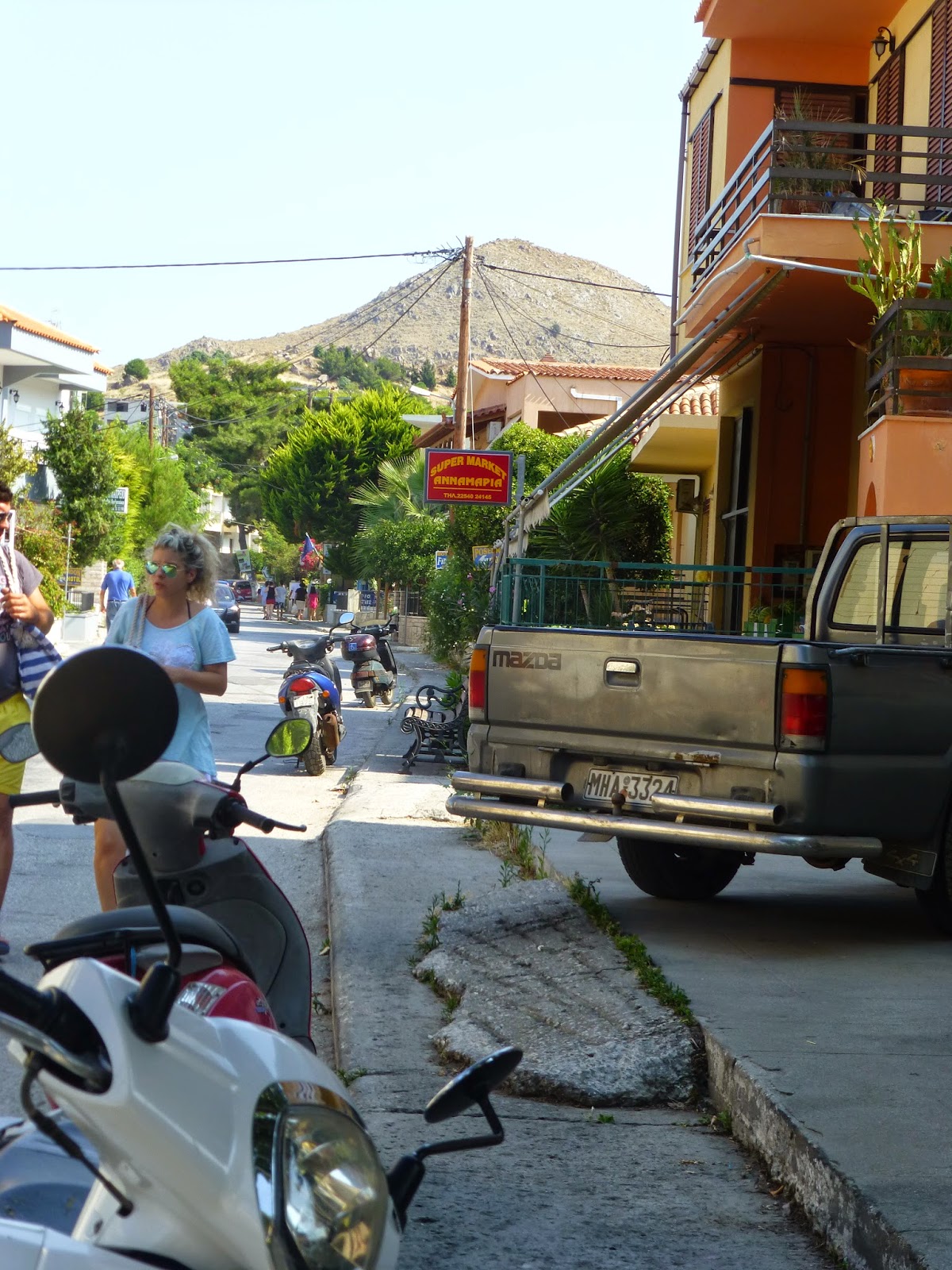
Coming to the island for so long we no longer feel we are tourists, so we are no longer concentrating on the sun, sea and quaint houses, so perhaps we notice the untidiness more; the flower pots, chairs, rubbish bins, large signs indicating today’s menus, trees, parked cars and motorbikes all  on the pavements.

A disapearing pavement
 I often get annoyed with this aspect of Greece; that pavements are no longer the preserve of walkers, and that old ladies and young women with prams have to share the road with cars. And when I take a walk I have to keep a continuous look out for the aftokineto bowling around the corner at high speed, or be ready to jump when a Lemian kalikantzari roars past on his motorcycle. 

Side street leading house and street repairs


Side strees for parking

Nevertheless…


I too take the beautiful pictures to send the family.

While….


Acknowledging that, though sometimes annoyed, it is often the other aspects of Greece that make it a memorable stay!

And usually you walk on the roads


Three shots from the same spot


Three shots from the same spot


Three shots from the same spot