Translate

Showing posts with label Timeless Lemnos. Show all posts

Sunday, 30 August 2015

Typical of Our Village


Typical of Our Village

One cannot say there is a typically English person, or Australian or Greek, as we all vary, but we do often vary from a norm. And it is the norm I’m writing about in this blog, the normal behaviour found in the two villages I live in.

I’m thinking about this now that I’m back in Australia again, and as I find myself checking out Lemnian behaviour against the behaviour of folk I meet in the Dandenong Ranges – specifically those in Emerald against those I’ve meet in Myrina.

Lemnians watching their local band

Folk from Emerald listening to an army band.

 What also prompts this speculation into village behaviours is that at the moment I’m reading Jan Morris’ Venice, a wonderfully descriptive book about that city and the people that have lived there.

Having done quite a lot of study in sociology (which included observing the behaviour of people in five different communities) I am fascinated by the way some studies, by sticking to statistics to find ‘norm’, miss asking some questions though I have to add that I can see why academic sociological studies, while often revealing the political pressures that maintain ‘norms’, often avoid delving into the history behind these norms. 

For example, from a description of another village not so far away from Emerald I read

Smalltown’s ethnic homogeneity is on of its most striking features. Less than 5 per cent of Smalltownites were born outside Australia (most of these are of British descent), whereas 25 percent of Victoria’s population were born in other countries.’
And
‘Given its Anglo-Celtic origins it is not surprising that over 90 percent of Smalltownites describe themselves as Christian and claim that they belong to a particular Christian denomination.’
Ken Dempsey

It’s not really fair to compare a book written for research purposes to a travel memoir but it does illustrate something missing (some perhaps sometimes questionable facts) that when I wrote about our experience in Greece I wanted to include. Subsequently when I wrote ‘It all Began with the Watermelon’ I wanted to include some psychology, some history as well as some sociology!

I included my own and my husband’s story, plus stories of the family that build the house, and even stories of long ago that I felt shaped the place we were living in. Thus it was such a pleasure to see this ‘wholeness of experience’ in Jan Morris’ Venice. 


Here is just a taste of Morris’ lovely descriptive writing from chapter two, The Venetian Way, where he describes the meeting of two women shopping. You already know they are in a Venetian street and you can almost visualise this event. And then in the same chapter he proposes some reasons for both this ‘hard-faced’ intent, and the seeming ‘commiseration’ of the meeting where both show a willingness to share ‘tender’ and ‘protracted’ exchanges of greetings.

Observe a pair of Venetian housewives meeting, and you will see reflected in all their gestures the pungent character of Venice. The approach each other hard-faced and intent, for they are doing their shopping, and carry in their baskets the morning’s modes purchases… But as they catch sight of each other, a sudden soft gleam of commiseration crosses their faces, as though they are about to barter sympathies over some irreparable loss, or share an unusually tender confidence. Their expression instantly relax, and they welcome each other with protracted exchange of greetings…’

Ways of Doing Things


Without her skill I’m now looking at my two villages, to discover more about the ‘Emerald’ and ‘Myrina’ way of doing things. I might even write a follow up book to that first one comparing the these two villages, that have many similarities, but whose differences highlight behaviours of the other. While it may seem that I’m generalising I like writing from my own experience and as one sociologist wrote,

Experience becomes a mode of testing and exploring the ways in which our experience conjoins or connects us with others rather than the ways they set ups apart.’
Michael Jackson

And if we watch and think about the way people move through their village we can learn a lot about that village. And as another writer put it

No one like to be thought of as ‘typical’, yet everything we do reveals something about human nature that is common to us all. The citizens of Southwood (his imaginary village) are unique individuals, of course, but they are also members of a community that is, in many ways like human communities everywhere.’ 
Hugh Mackay.

Folk from Lemnos and the Lemnian Way

I sometimes think I can tell a Lemnian by their face. I’m not good at facial recognition and because of this slight similarity I often nearly respond to someone I meet on the street and then realise it is not the person I thought it was.

Of course there are many new settlers on the island, later arrivals from nearby parts of Greece. Takis often says the blue-eyed men he sometimes encounters probably descend from the shepherds from north, from the mountains of Macedonia. And I know from experience many from other Northern Aegean islands marry Lemnians, but I think I can often pick out the true-born Lemnian.

 Lemnian Women

Coming home from church

Visiting with Family

Taking a Morning Walk


The women are short, with a short torso, and have soft rounded faces, with a pleasant aspect. 


Lemnian Men


At Work


At Play


The men are short and stocky with a good head of hair that turns white with age. They do not usually go completely bald, and if over 50 will be clean-haven. These men are often bow-legged and both sexes tend to walk with a sway, somewhat splay footed.


The men have a gentle and reserved manner, they are sociable and love to gather in tavernas and joke mildly about the foolish ways of mankind. The women too are sociable but less given to sitting together in groups unless it is a meeting of a club. 


Dressed for a National Celebration

Meetings on the Street


Men and Women will greet each other with a number of sympathetic enquiries when they meet in the street. These will be shorter in the summer, when there are many strangers around, and not include those asking about husbands, sons, daughters etc. and may then be only a slight wave and a couple of general questions, but always ending with a wish for a ‘Kalla’ day/ lunch/afternoon/ evening/ week/ month/year, which ever is appropriate.

But always there will be that complacency that comes from knowing they are Lemnian, and know just how a Lemnian should behave.

A Local Picnic

Folk Dance Concert


Sunday, 14 June 2015

The Local Ladies Bus Trip (plus some husbands)

The Local Ladies Bus Trip (plus some husbands) 


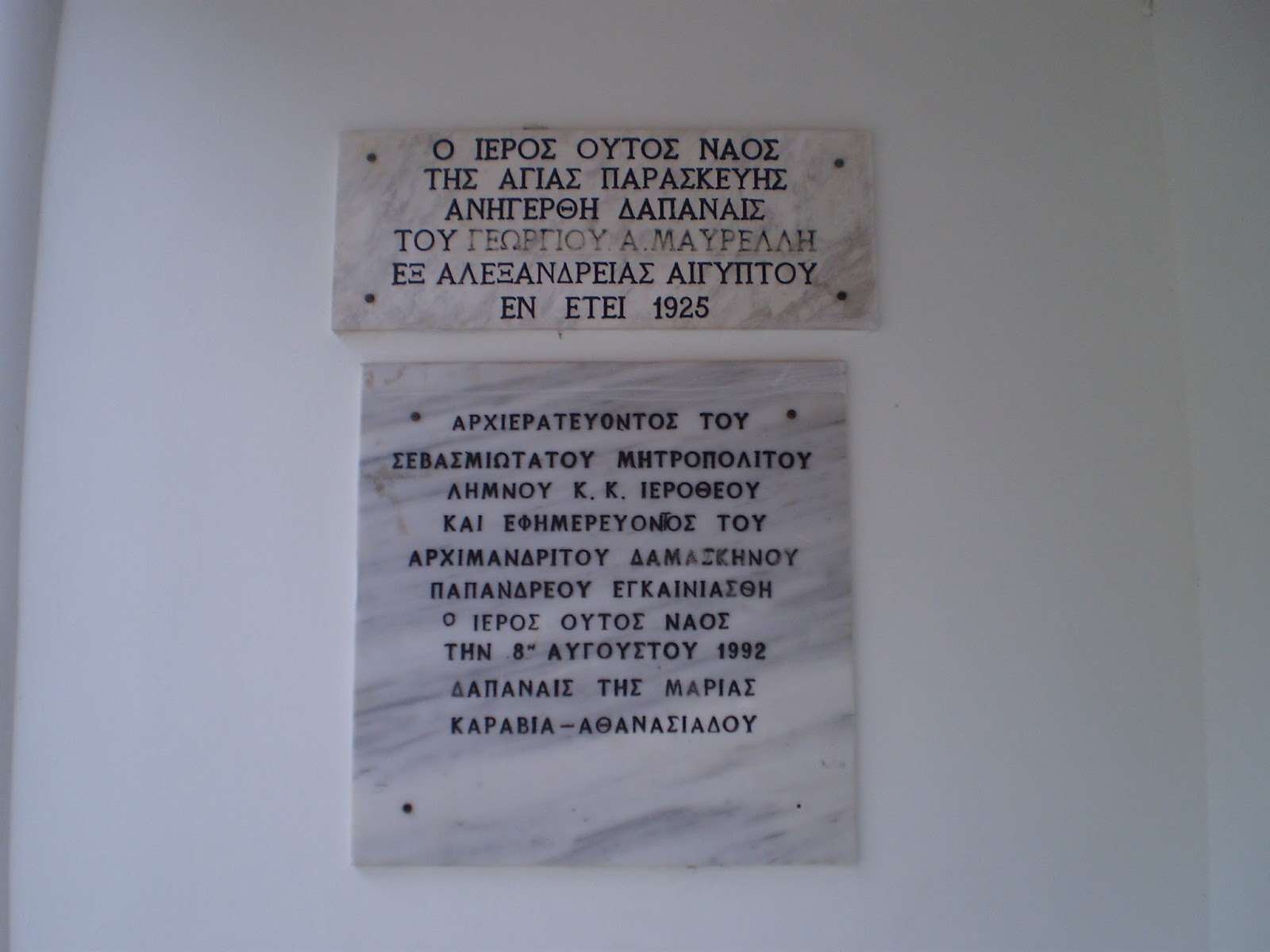
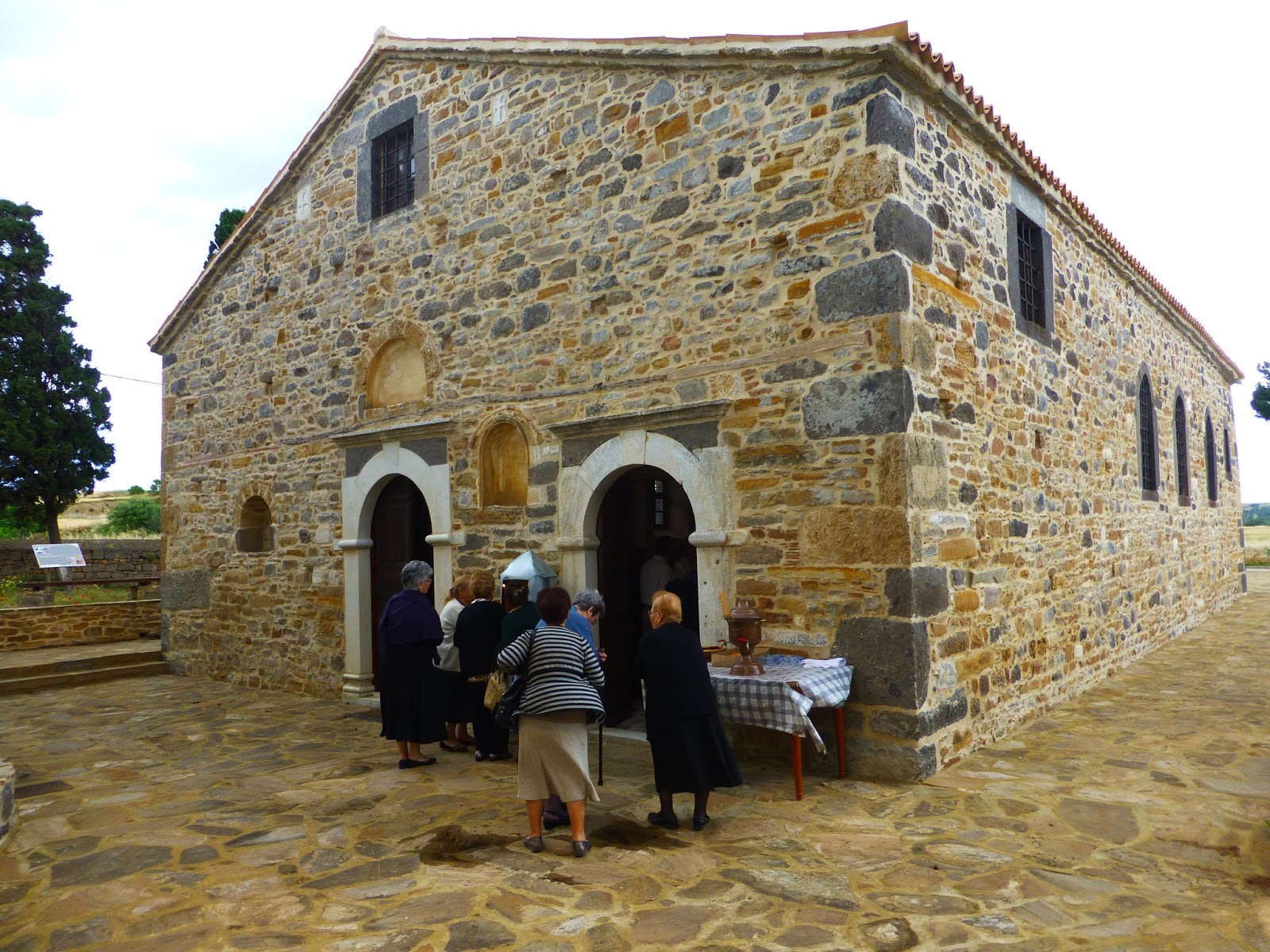
You may be familiar with white painted Greek Churches, but have you looked inside them? One in Myrina harbour is lit at night, a white church high on a hill. This church looks out towards Mount Athos on the mainland. Another well known Lemnian church, just below the Casto we can see from our house. This was erected in 1925 by Takis' Grandfather


Once when my son was visiting we realised that grandfather George's name was wearing off so Chris went with some cousins to ink his name in again.


But Greek churches are more than just white painted buildings. When you enter them you'll be amazed; by the chandeliers, the paintings, and icons. So when I was told the local ladies were visiting churches on their annual bus trip I joined them.

Winding through narrow streets with only inches to spare on each side of the bus.


The ladies from the part of Myrina where we live take a tour around the island each year.  Each year they choose a different theme, this year it was historic but less visited churches.


Inside each there was so much to look at;  saints on pillars on ceilings and walls and all the paintings glowed in the light of the chandeliers.


The paintings were often very old and intricate


There were old and new icons


And beautiful and skillfully embroidered cloths


And now and then we'd stop for coffee or lunch!


A Great Day was had by all!


on the island.

Wednesday, 2 July 2014

Sailing to Lemnos part 2

Sailing to Lemnos Island, part 2


When Sail Boats got Engines

 
A Turner painting of steam and sail


The Mavrellis Family Coming to Lemnos

Takis grandfather George and grandmother Ephterpi become wealthy enough in Egypt to hire their own boat once a year to bring their many children and servants to Lemnos for their summer holidays. Evidently they also brought two cows with them as well. One was slaughtered immediately for meat, while the other was to be killed half way through their stay. Perhaps this was because there are few grasslands on the island and beef and dairy products have rarely been on the menu. The few cows that were kept here in those days were used for farm work and were too precious to kill for food. In Lemnos only the oldest cows were traditionally slaughtered. Still today beef is rarely eaten and chicken and pork are the more typical meats on offer in tavernas.
 
The First World War, Lemnos and Gallipoli

A boat on its way to war

Each May the islanders still remember the 1915 attack on Turkey by the allies. Before the invasions of Gallipoli Lemnos had sheltered more than 30,000 soldiers and Moudros had over 300 ships anchored in the bay. Among those camped along the shoreline at that time were many soldiers from Australia and New Zealand. The injured soldiers were ferried back to Lemnos and housed in temporary tent hospitals set up along the shoreline.

Some boats in Moudros Harbour before they sailed for Gallipoli

 
In Australia commemoration services are held for the hundreds that were slain in that war on April 26, with dawn services and marches all across the country. Not many of the old Anzac soldiers are left to join in the marches now, and it’s their grandchildren who walk alongside today’s soldiers wearing their grandfathers’ medals.

 
One of two WW1 cemetries in Lemnos


Hard to decipher, but shocking to read.


Those who come are struck by the peacefulness of this place


The Anzac story is one that touches the hearts of many younger Australians, and today a growing number of youth make the journey to Turkey for the commemoration service at Gallipoli. Next year is the 100 anniversary of the 1915 attack and it is expected that many will journey again to Lemnos for a remembrance ceremony. 


Charter Yachts


Many tie up in the Myrina port, others in Moudros harbour. Many, as their flags tell you, come from England, Turkey, France and even Australia.


A typical harbour for charter vessels


But in harbour you have to watch out


A holiday vessel in the Aegean


A holiday village offering sail boat experiences


Tourist Trips


Our grandchildren love
Trips on a local wooden boat around the island of Lemnos,
or even to a nearby island called Ayios Efstratios.
 
This boat is called 'Anemos'
                                                                       daily trips,
                                                                                    bookings
                                                                                              6946212294
                                                                                              6945132163
Catching a Local Ferry


The main ferry service Nel Lines who arrive from Thessaloniki once a week and from Kavala more often. From Lemnos you can catch ferries to these ports, or to Lavrio port near Athens, or to some of other Aegean islands such as Lesbos, Chios and Samos.


Some shipping lines from lemnos
See Nel Lines
Pravlis Travel, Online Bookings: www.pravlis.gr

Sunday, 29 June 2014

Sailing to Lemnos Island, part 1

Sailing to Lemnos Island, part 1.


Myrina Harbour Today

Odysseus’ boat


An early settler on the coast of the Mediterranean would see the chain of nearby island and been tempted to sail from one to the next. They might be merely thirteen miles away and a boatful of men could easily row from one to the next in half a day. Around 4000BC there were sail-propelled boats on Euphrates some of these could reach Egypt.


Odysseus setting out (my painting)
Odysseus returning home (my painting)


Aronauts Searching for Gold


The Black Sea was the main destination for island traders. They went to settlements around the Black Sea to barter, taking pottery, oil and wine and bringing back copper and gold.

  
Now the sea is the Argonauts’ sea, and in the dawn
Odysseus calls the commands, as he steers past those foamy island;
Wait, wait, don’t bring the coffee yet, nor the pain grille.
The dawn is not off the sea, and Odysseus’ ships
Have not yet passed the islands, I must watch them still.
The Argonauts by D.H. Lawrence

 
The Argonauts is a name given to a group of young men who set off to in their boat the Argo to find gold on the coast of the Black Sea. Their first landfall was Lemnos.


A Lemian Myth


At this time the island was said to be populated entirely by women. The story is that when their husbands turned away from them in favour of slave girls from the Thracian mainland, the Lemian women had taken murderous revenge upon their husbands and the slave-girls. When the Argonauts arrived they were happy to have the Argonauts stay with them. The men, following Jason’s example married these women– his choice naturally being their leader, Hypsipyle.

 
 Passing Greek and Roman Battle Ships


Long before boats had guns wars were fought at sea between wooden and sail boats. The aim then was to ram the other boat and cause it to sink. One of the largest war ships of ancient times was the Greek trireme with fifty rowers, placed in three rows, one above the other.


 And Often There were Pirate Ships


An embroidery of an old boat in the house.


I have seen old ships sail like swans asleep

Beyond the village which men still call Tyre,

With leaden age o’er cargoed, dipping deep

For Famagusta and the hidden sun

That rings black Cyprus with a lake of fire;

And all those ships were certainly so old

Who knows how oft with squat and noisy gun,

Questing brown slaves or Syrian oranges,

The pirate Genoese

Hell-raked them till they rolled

Blood, water, fruit and corpses up the hold.

Old Ships by James Elroy Flecker


A strange ship might be bringing goods to the island, but also it might be a pirate ship, and so strange ships were not always welcome.


Pirate Hideaways


The story of one Lemnian village attacted by pirates


At one time the pirates used the island’s large bays as bases from which to go out into the Aegean waters and attack passing craft. The pirates caused a lot of destruction to the island. It was fear of the pirates that caused the people to build fortresses, and also the reason many villages were transferred from places near the sea to the interior of the island, to higher, hidden and safer places. The pirates were often more feared than the Venetian or Turkish overlords. At least the Venetians improved the agricultural production and the Turks ensured stability, helping rid the waters of the pirates.

 
It was during periods when pirates attacked often, or brutal overlords demanded slaves and goods, the people left the island and immigrated to other sites such as Thessaloniki, Crete or settlements around the Black Sea.


Things don't change!!!


Unfortunately even today we still have pirates


 Somalia has the longest coastline in mainland Africa and piracy flourishes. The young men have probably been dispatched by a local warlord to bring back loot. In roving gangs of perhaps 10 men they take to sea with just drinking water, gasoline for their outboards, grappling hooks, ladders, knives, assault rifles, rocket-propelled grenades, and they live on raw fish.