Translate

Showing posts with label Greece Today. Show all posts

Saturday, 24 October 2015

Micro-Climates of Greece


Micro-Climates of Greece
 

Greece is a small country that covers a large area.


The country closest in landmass to Greece is England, with an area of 130,395 km2 as opposed to Greece's 131,957km2. Another comparison could be with the US state of Alabama. (you can fit both Greece and England into the state of Victoria, which is one of Australia’s smaller states.)

Greece is bounded by three Seas, the Aegean, Ionian and Mediterranean Seas, and its coastline is estimated to be 13,676 km (8,498 miles). It spreads 772 km (480 miles) from east to west and 940 km (584 miles) from north to south – with Athens roughly in the center. If you travelled from the very north of the country to the very south it would be like travelling from London to Barcelona, or if you were in Australia,  something like travelling from Melbourne to Sydney.

Thus, just because of the differences in Latitude the Greek climate does vary from north to south.

Islands and Mountains, and the Mediterranean Climate.


Greek summers are hot and dry, while winters are cool and rainy. Thus Greece generally has a temperate Mediterranean climate. The average July temperature is 27°C (80°F), with the thermometer topping 38°C (100°F) on the hottest days. And rainfall increases from south to north, ranging from 41 cm (16 inches) in Athens to about 127 cm (50 inches) on the island of Corfu.

However, because there are so many mountains (80% is mountainous) and so many island (20% is islands) this caused differences as climate is moderated by both sea and mountain breezes.

Greece is primarily a mountainous country with more than 300 larger or smaller mountains. The most significant Greek mountain axis is the Pindus Mountain range, forming the “backbone” of Mainland Greece, it extends naturally to the mountains in the Peloponnese, and to Crete. Other mountain ranges extending into the sea as peninsulas (one ends with Mount Athos), or chains of islands.

The large number of islands are estimated to be from somewhere around 1,200 to 6,000, depending on the minimum size to take into account. The number of inhabited islands is variously cited as between 166 and 227.

Variations in Climate
So, while the climate of Greece is generally Mediterranean, due to the country's unique geography it has a remarkable range of micro-climates and local variations. 

The weather at the higher elevations is colder and wetter, and mountains, and northern areas, receive snowfalls and frosts in winter. You can even get snowfalls as far south as Athens or even Crete at times.

You can find at least three main types of climate in Greece.

Alpine
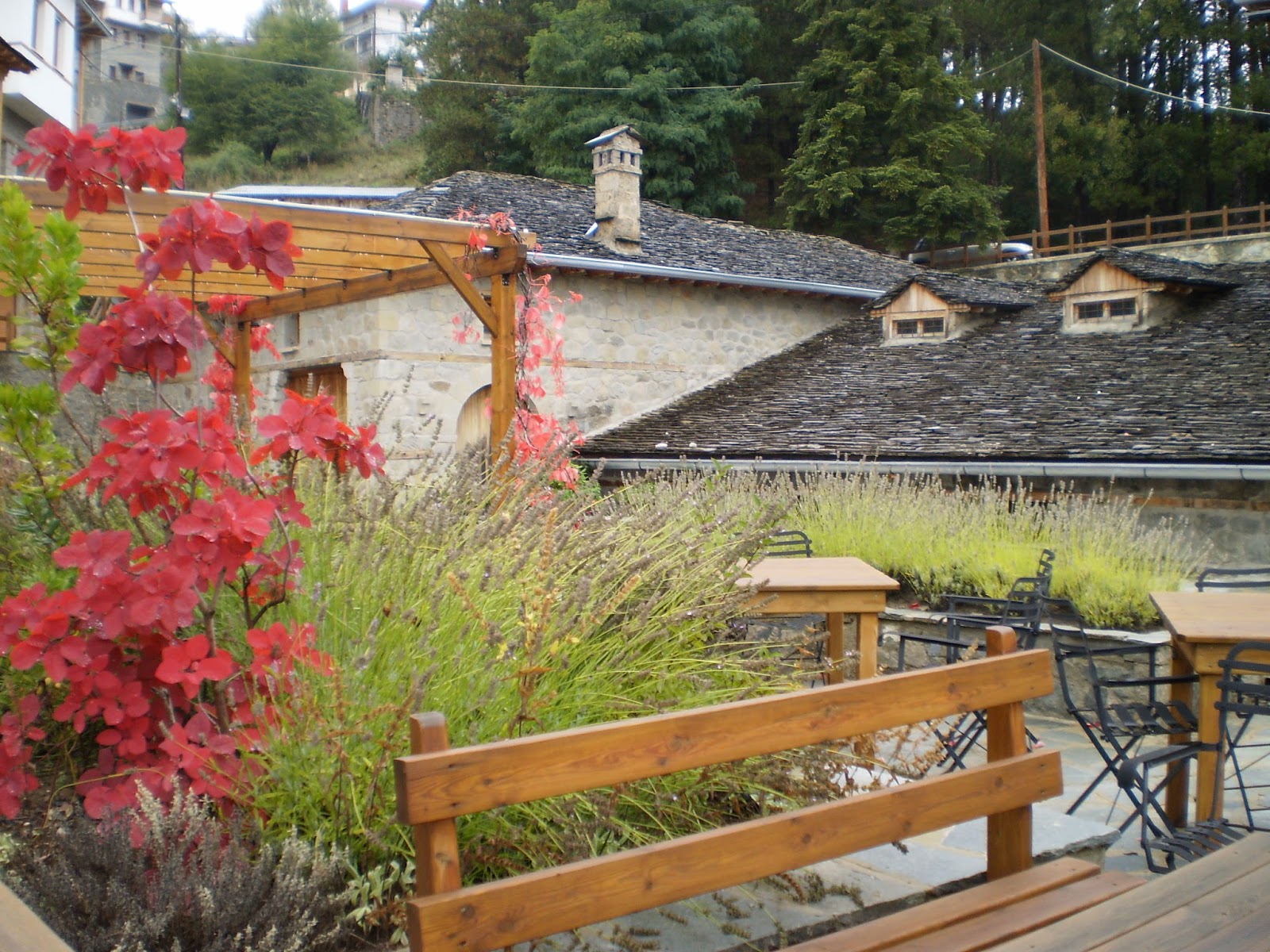
Folk are often surprised to find there are Alpine areas in Greece. In the north-west you might think you are in Switzerland with its chalets built on the mountain slopes.


Mild Mediterranean
Then there areas were the temperatures rarely reach the extremes, although snowfalls do occur occasionally even in Athens and Crete during the winter. But all things have to be taken into account when looking at the climate of a particular area, or island. Take Crete. It has a fairly mild temperature although being the most southernmost island with summer temperatures of 25-6 and winter temperatures around 10-12. This is because it is surrounded by seas, away from large landmasses, with many tall mountains. So Crete benefits from both sea and mountain breezes in summer, and being so far south rarely has snowfalls. 

Crete
Crete


Hot Mediterranean
And there are the areas where they have very hot dry summers, and colder damp winters.


Rhodes
Rhodes


Rhodes another southern island is much hotter and drier with summer temperatures of 29-30 and winter temperatures around 10- 15.

Lemnos – The Windy Island

Lemnos
Lemnos is a Northern Aegean island. It is the 8th largest Greek island, once volcanic now it has low rounded hills and indented deepwater bays. It was formed by volcanic action and it does not form as a part of a physical chain or group. However the island is frequently grouped together with other Northern Aegean islands (Lesvos, Thasos and Samothraki) for tourist or administrative purposes.

A feature of Lemnos is that it is mostly flat (hence its many sandy beaches), and it has more arable land than many other islands. Thought the northwest part is more is rough and mountainous with Mount Vigla the highest elevation (470m).

The temperature is typically 2 to 5 degrees Celsius less than in Athens, and than Thessaloniki, its nearest large town. The average high in July is 29.0, and the average low in January is 4.2.
Summertime at a Lemnian Beach
Winter Hail in our Garden
 You could say Lemnos has a mild Mediterranean climate, but because of its position it can get winter winds from Russia, and summer winds from Egypt and so winters will have frosts and occasional snowfalls. However the strongest feature of this island are its winds. These may be welcome when they come in August, but in winter they bend the trees and keep everyone indoors. Hence the nickname for Lemnos, "the wind-ridden one" (in Greek, Ανεμόεσσα).
Me in Lemnos port in January
 I’ve found its not always easy being a gardener on Lemos because those hot and dry summers, that can extend for three or even four moths, and because of the frosts and winter snowfalls. Then, in addition, there are those winds! However with trial and error I continue to garden and now love my practical and very beautiful Lemnian garden. More about those trials and errors in the next blog.


Sunday, 9 August 2015

Greek Laws: Revoked, Interrupted, Repeated


Greek Laws: Revoked, Interrupted, Repeated.

Confusion.............

According to statistics it seems that Greeks feel depressed and lonely, that many are out of work and that salaries are low, but that their life expectancy is longer than most Europeans, they eat healthier, and they retire earlier. Should we feel sorry or envious?

Then, when it comes to education, we hear the same kind of confusing stories; that Greece has the highest rate of university degree holders and that its educational system is better than other countries, but also that the education level is lower than other EU countries. And, I’m always being told by friends with children that they have to send them out to private evening schools to catch up and pass exams. What does this mean?
 

I’m guessing that this kind of disconnect is about incorrect statistics.


I wrote a blog recently about the long term difficulties that Greece has to deal with in terms of its history and geography. But Governance is also a problem.


It's also about Episodical Governance.


Previous governments have tried to deal with the Greek problem of students, with the thousands of so-called ‘eternal students’ enrolled at Greek universities who take ages to complete their courses. Evidently laws were passed in 2007 and again in 2011, and again and again. I believe the latest move by the Syriza government has been to revoke what the previous government did about this problem. They can again take as long as they like to get a degree. Why these change of faces?

I’m guessing these continual changes happen because of pressure put on the government by unions, by students, by wealthy parents.


In the last couple of years all in Greece were aware of the shut down of ERT, the government media station. The previous Samaras government laid-off 2,600 employees and closed the broadcaster down for a month. But this closure as an indication of the government’s commitment to cut back an excess of civil servants did not seem sincere when ERT was reopened with 2,000 workers as contract workers. And then the Syriza government continued to revoke the previous by move by hiring them all back!

There is a plethora of various laws and restrictions in Greece that render everything so difficult, and a plethora of laws disregarded that make everything so unpredictable. The result? Folk gossip and argue, and shout and riot, and march and wave manners, and re-elect new governments. While we were in Greece this year the tone of arguments, and of debates on the TV, spiraled upwards, and upwards. There would be five faces on the panel, all discussing and disagreeing with at each other. Then there would be ten faces around a huge table, shouting over each other.


Ordinary folk took to the street; they were worried by their government, by the media. It is the way things are done in Greece. Short elderly men in checked shirts, elderly ladies dressed in black and wearing glasses and they blamed the troika, the Germans, the EU. Reforms had been tough, but they had also been blown up into dramas of Ancient Greek Proportions. 


The latest government called the wrath of the Gods down on the EU for what was called their ‘intransigence’.


If only, if only, there was a consistency and unyieldingness about Greek law making!


One Greek paper wrote how this repeated procedure has eventually led to the loss of the country’s credibility. Adding

There is nothing worse than committing to something officially and subsequently not fulfilling your promise.’

And all this while, during the spiraling political panic of 2015 there was an elephant in the room that was ignored until it grew so big that another problem altogether has arrived in Greece.

Meanwhile.....

Refugees and Migrants in the Mediterranean

The Elephant in the Room!


Jan to May 2015

Italy 55,500

Greece 48,000

Spain 1,000

Malta 1,500


The number of migrants reaching Greece by sea has soared to 63,000 this year, overtaking the 62,000 who arrived in Italy by sea.
The voyage from Libya to Italy is longer and more hazardous. Migrant deaths at sea this year stood at 1,865 by 10 June, the International Organization for Migration (IOM) told the BBC. And of those, 1,816 died trying to reach Italy.

These figures are from the BBC.


Storm Clouds Over Greece

We are all hoping!

Saturday, 25 July 2015

Greek Politics 2015


Greek Politics 2015
 I find it is so very good to be at a distance from the Greek political drama, even though everyone still asks me what I think about it all.  

And because of these questions I’ve had to ask myself what I do think about what was happening. I know I still get very cross at the way it has been and still is being reported; with a selective group of people being interviewed and then the reporter putting their spin on their selection.

Newspapers being another lot of drama queens (beside the Greeks) they only want to portray ‘poor Greeks’ and ‘wicked Germans’ as that makes a better story.


The situation is much more complicated than that. But there are a few articles that go deeper if you search, and then you’ll catch a hint of a more complex situation. Unfortunately tourists and newcomers to Greece seem to expect that, as it is part of the EU, they’ll find similar conditions to those in other EU countries. When they read the papers they then may also feel the need to put the blame elsewhere.
 

For me it seems to me that Greece is not ‘European’, even though one of its myths has named that continent – named after one of Zeus' (as a bull) attempted conquests, that of Europa. Takis disagrees with me violently about this statement (that Greece is not European), but we do agree that Greece does not have easy solutions, and that many of its problems stem from its geography and history.


Because Greece is placed midway between that Europe and Asia, and it is largely composed of mountains and narrow valleys with hundreds of islands scattered in three seas, and while these formations of rock and sea are very beautiful this geographical structure has meant that groups of people have been separated, and though speaking the same language they have had to look after themselves – often with very limited natural resources.


And then, beside this, ‘Modern Greek’ society was shaped within the Byzantine Empire rather than within the Roman Empire, and today’s structures still reveal that history. Many Greek organizations are antiquated and overly complicated, having missed out on Rome’s organization ability.


What did Rome offer Europe?


Pax Romana (Latin for "Roman Peace") was the long period of relative peace and minimal expansion by the Roman military force experienced by the Roman Empire after the end of the Final War of the Roman Republic and before the beginning of the Crisis of the Third Century.

While some others summarize this to mean that ‘In other words, imperial peace becomes civil peace insofar as the memory of the previously independent political units are effaced, insofar as individuals within a pacified zone feel themselves less united to the traditional or local community and more to the conquering state.’ 

And this might be what many Greeks felt about the EU! that they were being ‘pacified’ and ‘conquered’! However, Rome did give Europe a good foundation for later development. It gave Europe a network of roads, which in turn meant a means of communication, and along with that it provided a very efficient administration that ensured relative peace for hundreds of years. 


But the newspapers love the drama of the present situation in Greece, and rarely look at the present impasse in terms of Geography and History. 

While, in Greece, there is reluctance to make real change, because that would require a dramatic life-style reorganization.


Greeks in Australia

Nick Xenophon, a well respected Greek Australian who is an independent MP


From Wikipedia: 
Australia is home to one of the largest Greek communities in the world. Greeks are the seventh largest ethnic group in Australia, after those who declared their ancestry simply as "Australian". In the 2006 census, 365,147 people reported to have Greek ancestry, either exclusively or in combination with another ethnic group. The largest concentration of Greeks in Australia is in the state of Victoria, which is often regarded as the heartland of the Greek Australian community. The latest Census in 2011 recorded 99 939 Greece-born people in Australia, a fall of 9.1 per cent from the 2006 Census. 


Lemnos Politics: 2015

These are people who are calm and stoic, less driven to Greek dramatic outbursts. I can’t say if this is typical of most of the island peoples, or of folk who do not live in the major cities. I do know that there are many who are socialists and many communists in Lemnos, and Syriza had a large following on the island. And I also know they are tired of the long drawn out disputes, and the uncertainty about banks, about ferries. 

In the referendum their vote was counted with that of the island of Lesvos, 38% Yes, and 61% No , a result that largely mirrors the final outcome for the whole of Greece. But many voters were confused as to what they were actually voting for as both the EU and their government told them that it was also about staying in or leaving the EU, something most did not want to do.

And with what has happened since, confusion all round!


Two articles in the Melbourne newspaper The Age

These are typical of the coverage of Lemnos in the Australian press this year. 

John Pandazopoulos wrote this article. He is President of the World Hellenic InterParliamentary Association and a former Victorian Minister for Tourism, Employment and Major Projects and was member of the Victorian Parliament for 22 years. He writes, ‘You won't get a receipt for most things you buy in Greece and that is why no Greek politician will talk about something that will fix the budget – tax collection.’

The other articles that mention Lemnos are mostly about the 100th anniversary of the landing of the Allies in Gallipoli. For example,

A collection of letters that gives amazing insight into the lives of nurses who tended wounded soldiers evacuated from Gallipoli.

And my answer to folk who ask about the Greek Dilemma

I feel that any modern advance towards the ‘European ideal’ (while desired by well over half of the population) has long been held back by these constraints, it is a situation that requires different and complex answers to those of other European countries. For instance, there needs to be better access to the 400 or so islands and organizations less tied to Byzantine and religious formulas.