Translate

Friday, 5 September 2014

The Garden at Summer's End


The Garden at Summer’s End


Jasmine Hedge. a second blooming


Summer Heat - Water with Care


The Castor Oil Plant (Ricinus) has poisonous seeds.
It nees some water but is startling beautiful as this time of year.

 
We have just arrived in September. Our well is dry, has been for nearly a month. And though storms and rain have been experienced in other parts of Greece they have all managed to just miss our island.

 
The Pampas Grass has just burst out in bloom. This plant needs no water.


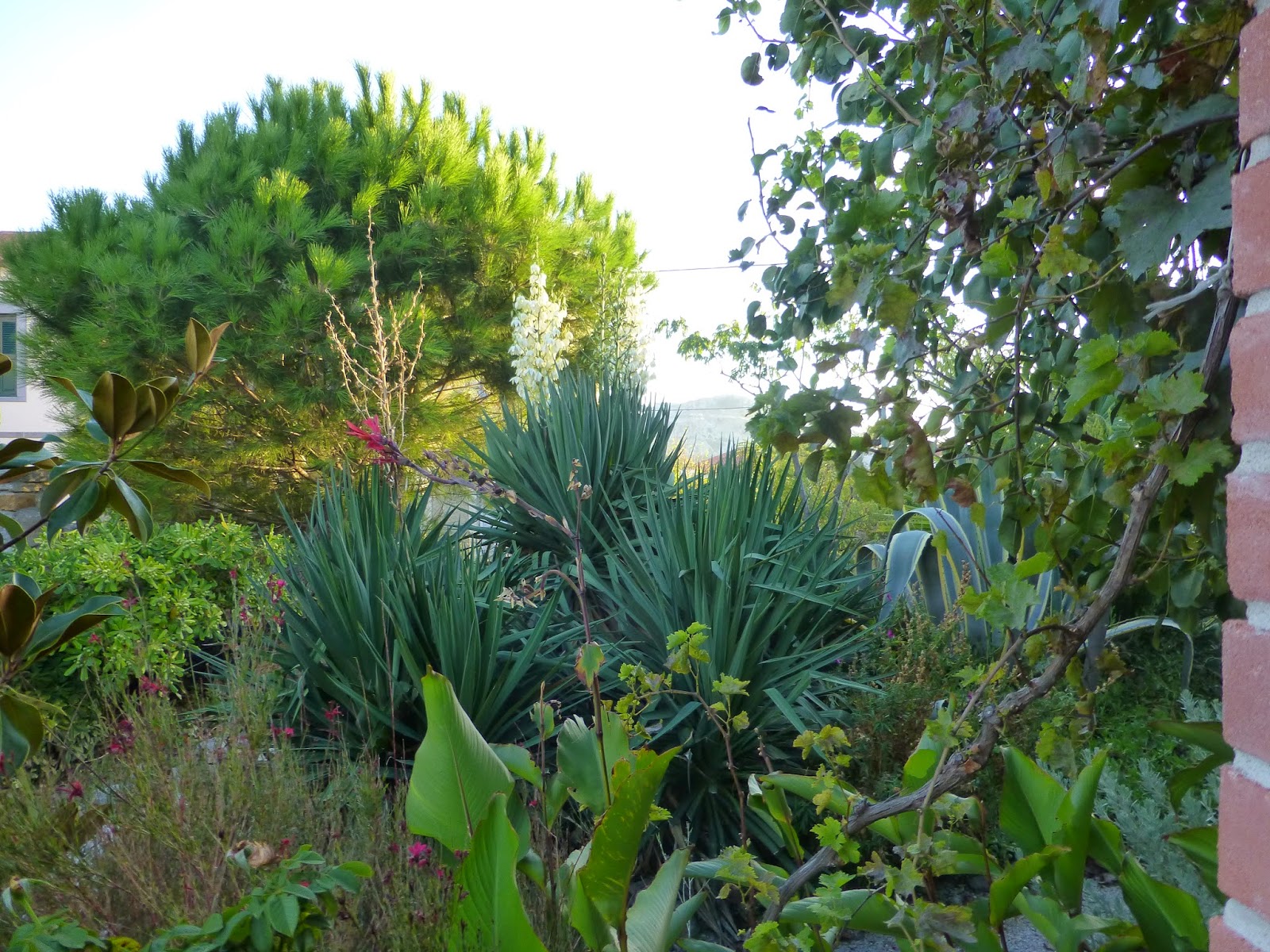
Our Yucca has just burst into bloom, its second blooming this year
Another plant that does not need watering.


Dry Summer
by Jim Gustafson
My pomegranate is not fruiting yet, this one is next door.
Great is the sun, and wide he goes
Through empty heaven with repose;
And in the blue and glowing days
More thick than rain he showers his rays.

Though closer still the blinds we pull
To keep the shady parlour cool,
Yet he will find a chink or two
To slip his golden fingers through.

The dusty attic spider-clad
He, through the keyhole, maketh glad;
And through the broken edge of tiles
Into the laddered hay-loft smiles.

Meantime his golden face around
He bares to all the garden ground,
And sheds a warm and glittering look
Among the ivy’s inmost nook.

Above the hills, along the blue,
Round the bright air with footing true,
To please the child, to paint the rose,

The gardener of the World, he goes.

 Summer Light – Big and Bright

 
Our usual August guest have left to go back to their own island or Australia.
We are dressed conservatively compared to Lemnians! But are now nicely tanned.

Summer clothes on the island often pick up the bright zinnia's colours
The people have gone but I remember the bright colours. Greeks turn a smooth milk coffee brown or a dark and shiny espresso brown. So much bare skin, but what they wear with that brown skin will be brightly coloured, probably florescent. Orange is a favoured colour in Lemnos, but in summer so is florescent green and blue. Sunglasses nowadays are also fluorescent. At least the colour can compete with the sun!


More zinnias

Summer Sun
from A Child’s Garden of Verses by Robert Louis Stevenson (1885)

Great is the sun, and wide he goes
Through empty heaven with repose;
And in the blue and glowing days
More thick than rain he showers his rays.

Though closer still the blinds we pull
To keep the shady parlour cool,
Yet he will find a chink or two
To slip his golden fingers through.

The dusty attic spider-clad
He, through the keyhole, maketh glad;
And through the broken edge of tiles
Into the laddered hay-loft smiles.

Meantime his golden face around
He bares to all the garden ground,
And sheds a warm and glittering look
Among the ivy’s inmost nook.

Above the hills, along the blue,
Round the bright air with footing true,
To please the child, to paint the rose,
The gardener of the World, he goes.

 
The dry garden, now that other plants have dried, is spectacular with it Fan Palm and Yuccas.


Thursday, 4 September 2014

Dogs, Cats and Summer Rain


 Dogs, Cats and Summer Rain

Summer Rain

In England we have an expression for a heavy downpour, ‘It’s raining cats and dogs’. In Greece they say, ‘It’s raining chairs’.

Greece has just had a lot of rain, which, as often happens, just missed our island. A good downpour would have cleaned the place up but we had just a light sprinkling, just enough to make the island smell of cat piss.


A cute, but very thin, stray


Some things have changed in Greece but the stray cats and dogs are still around. Some years we seem to have an abundance of cats other years its packs of stray dogs.

Sometimes I think I should not wrap up my rubbish so that they can get a feed more easily

Dogs


Today when Vetta came for morning coffee she came under an umbrella. Lemnos is surrounded by water so the temperature is equalized giving the island a temperate in spring and autumn. Maria had been cleaning the house and so she also joined us. The discussion was about the cleaning program that Maria was working out, to accommodate various other summer arrivals in the houses around us. And it was also about dogs, as Maria tried to interest Takis in having a dog. Vigourously saying we did not want a dog we found out that it was Anestis who had given way to the boys importuning and allowed them to keep a dog. He had even built a kennel for it after Maria banned it from the house. But, now the boys were getting tired of feeding it, looking after it had become her job. 


A lot of homes, and farms, have dogs

‘Now you want to pass it on to me!’ Takis, with many gestures berated her. ‘I have enough trouble with our neighbour’s dogs.’


Takis was not particularly impressed by the idea having been woken at two that morning by the barking of one of our neighbour’s dogs. And the day before we had been woken by a pack of dogs attacking a cat!


End of August, the hoards have left


One week the beaches are full, the next they are empty
The problem is that at this time of year the holidaymakers leave. They have come with their cars, children and dogs. The dog was probably a Christmas or birthday present of a ‘cute little puppy’, but now that puppy had grown up and is an annoying, untrained, yapping dog. And there are some folks that think the best thing to do is to leave it behind on the island when they drive onto the ferry to return home.


This is NOT a lost dog. It belongs to the pharmacist!


This one too belongs to someone. Lets hope they keep looking after it.

Regularly, at the end of August the island has a pack of unwanted dogs. This morning when I went for my usual walk I passed seven, all by now looking scruffy, hungry, and still hopefully looking for their owners!

Lost dogs tend to try and belong to you!

Another island ‘dog’ stories include those about a huge growth in the number of pet dogs. Takis and I put this down to a new TV program about keeping pets, in particular dogs. It is a program put on in Australia too, as it is compared by an Australian vet, by the name of Dr. Harry. Anyhow at about the time this program was aired suddenly it was extremely fashionable to walk your dog on a lead. Never mind if when you got home you let it run freely around the streets! This fashion continues, and to cater for dog needs there is now a vetinery shop, with a waiting room, near our house.

Cats


Cats are endemic in Greece and jump out of dustbins, hide under cars, and have at least two litters a year. They are cute. They feature on Greek calendars. But they are strays. One year when we returned the usual stray cats were not around the garden, not even around rubbish bins. Another year they appeared to have disappeared over winter.  We heard from our neighbour Vetta that the packs of dogs that winter had even been attacking the young deer that live up on the Castro Mount. I think the council must have finally rounded them up.


A cute, fat cat


And another well cared for cat
This year so far the balance between cats and dogs has been maintained but the sounds of that dog/cat fight last night does not bode well for the island cats this winter.

And Other Beasties


The mice have returned. The usually try to set up home in the house just before we leave as the weather gets cooler. But this year they started appearing in mid-summer.

Takis and I began to fight back with our snap traps, but unfortunately we had visitors that objected. These were very sensitive souls who have not lived long in old houses, nor in the countryside. So the first two caught in a box were carefully lifted out and carried out into a nearby field. Now, whether those two came back or it was an earlier family, now grown, or more have come to join their cousins I’m not sure, but more have arrived!

I too don’t take pleasure in getting rid of them. I too have to screw up my courage to kill snails or mice but it has to be done if you want a clean house, or a lush green garden.


I have hoards in my garden in spring. I can collect a bucketful!


And even snails are 'cute'
And I know mice have cute little faces, cuter than cockroaches, but they have no place within a house. On the internet I found out that a family of 6 can become 60 in a month and that babies are fertile and begin their own families in 4 weeks. So before long, in an old house like ours, you find them in the attic, under the stairs, and behind the skirting. They love these dark warm places.

So far we have caught four babies in a box, and four adults in snap traps, sinc and disposed of them all. Though last night I could hear more scratching up in the attic above my bed! Oh the joys of country living!

Friday, 29 August 2014

Shutters - so Mediterranean!


 Shutters – so Mediterranean!

Shutters, so Mediterranean!

I’m writing this blog about something that is unique about a Mediterranean house and that is its shutters. But it is not just the look that is unique about this it is the daily routine of opening and closing shutters (and upkeeping them) that makes living in the Mediterranean distinctive.

They add interest to these plain square boxes of houses


The shutters from the inside, closed to keep out the sun


Lace curtain soften the hard outline of shutters and window


When we first came to the house in 203 the place was dark and shuttered. We cautiously ascended the stairs, and in order to better see what we were doing Takis opened the shutters in a couple of the rooms. Now we had enough light to make out the litter in each room: old furniture, battered pictures and broken ornaments. On the top floor we carefully we walked towards the shuttered double doors that led out onto the balcony above the front door. These doors had an extra seal, so that no one would inadvertently exit onto that precarious ledge. However Takis managed to open one, and immediately, there before us lay an enchanting view. Then in 204 when we really began work on the place,  Lisa, Takis daughter was with us for the first week or two, and the two of us went from room to room opening up a few shutters here and there before we began the work of clearing out the accumulated litter of past holiday makers. And, as we opened up one set of shutters a neighbour outside yelled up a warning at us, as he could see that the shutters were hanging by only one hinge and were in danger of falling down into the street below.
Having bought the house we found ourselves with a big house with many windows and many shutter. I once counted the windows, and as we slowly renewed frames, panes and shutters, and over the years, the number always left to renovate was one of the main items on our yet-to-do list. However, they are all now done, and we have even got to the stage, after ten years, of needing to repaint and re-repair some of them.

From the outside the shutters are one of the most distinguishing features of the house. We are proud of them. The first thing that many of our neighbours know about our arrival is that the shutters are open. They will greet us and say, ‘I saw that you’re here I noticed the opened shutters yesterday’. But that is not what this blog is about it’s about the process of living with shutters, and the fact that the shutters are one of the most important features of living inside the house.

Shutters require attention, to half-open, open fully or close, at least twice a day in summer - the rest of the year not as often. You use them to modify and equalise, the temperature inside all depending on the weather outside the house. To help in this delicate task we have indoor-outdoor temperature gages.


out-in temperature gage

another temperature gage - we have three!

Well, we also have these gages to help modify the arguments Takis and I have about the temperature. He always judges it to be cooler than it is, so 32 becomes 29 degrees in his mind, whereas 32 becomes 35 degrees in mine!


Not discussions about the wine, no, about the temperature today!

What happens is that each morning, sometime between seven and ten, depending on the weather (windy, cool at night, very hot in the morning) I go around and close, or half-close windows and shutters. And at night, sometime between sunset and when we go to bed, again depending on the weather (windy, cooler or hotter in the evening) I go around and open or half-open windows and shutters.


Some windows face north, and we leave these open nearly all the time in summer

There five of the windows on the top floor that gets this treatment and four on the middle or bottom floor.


Shutters half closed


Shutters opened and pinned back
Shutters back and window opened


We do have two air-conditioners in two bedrooms, but in this manner we keep the house as ecologically friendly as we can. And we are helped by the fact that Takis has put double glazed windows throughout the house. Fans come in useful too, and if we are in a room we will switch one on to give us that pleasurable feeling of transpiration convincing ourselves it has become a bit cooler.
 

Almost sleeping beauty's castle, when the creepers take over!

Post scripts:

1.      When the wind arises in the night the crashes and bangs mean you have to get up, and put cushions and chairs by doors and hold back those windows and shutters that you did not secure.

2.      I’ve just recounted the windows and shutters.

Top floor, nine windows and two sets of glass doors onto the balcony – all shuttered.

Middle floor, ten windows, and one glass door leading onto a balcony – one window unshuttered

Ground floor, six windows, and glass door onto terrace, only two shuttered.


Glass doorway to a balcony, with shutters pinned back


Glass doorway to another balcony, shutters pinned back

Sunday, 24 August 2014

Late Summer: A Time to Conserve


 Late Summer: A Time to Conserve


We're here on the island and have already had twelve guests staying with us, some for months, and we have another three expected in September. Good fun at times, but getting harder to come down in the morning to greet everyone with a smile. Takis and I are exhausted. So this is the time that we have to conserve every bit of energy we have.
Just like the garden, in order to keep going humans have to remember the need to rehydrate, replenish and resist doing too much!
 
The sweat is dripping down our bodies. It’s hard to work on the computer and I'm sure I'm making more mistakes.


And we try to keep smiling

Hot, but colour still happens, blue hybiscus


It’s Hot! And Humid


And Zinnias love the heat


A Time to Conserve in the Garden

In the summer in garden the heat depletes, and the water evaporates, the plants wilt and only a few hang on with some loving care.


A scond bloom of spindly roses


The end of the tomato harvest

Though the eggplants love this heat


And so do the peppers


Composting Waste
Waste disposal is an increasing problem because of a lack of space. Some studies have shown that up to 20% of waste going to urban recycling centres in Australia is vegetable matter. But it has to be done carefully. Unfortunately landfills are not the way to go, and rather than rot down into good compost they can just make piles of slime and give out unpleasant gasses.

But real compost is magical stuff. I have grown up knowing how important composting is for the health of a garden. My grandfather used to set out on his bicycle with a bucket and spade when a horse passed our gate. He would return sometime later jubilant, with a bucket full of horsey excrement for his allotment.

It is the result of a remarkable metamorphosis whereby leaves and stalks are transformed into a black crumbly mixture; a productive silt which when spread in the soil aids new life.
The idea of composting and mulching seemed to be a new idea to gardeners on the island. Anestis was sceptical when I asked him to build me two compost enclosures. But he was impressed to see how weeds and waste broke down by the end of a few months. The two compost bins he constructed for me were partially in the shade of a young olive tree, but this was OK and in the long hot Mediterranean summers I need some shade to assist by keeping the piles damp (I always water them on my way past, when moving the hose from one bed to another.) Then, usually just before we leave in autumn, Anestis digs out these bins and applies the well rotted vegetable matter to our clay soil.

Compost bins at the end of a path

Filled compost bins, ready for autumn emptying

Mulch

Mulch is something else you have to think about in summer. It is necessary to protect roots from severe heat. Mulch can be hay, newspaper, dried weeds, empty almond shells, etc. It will not only protect the plant but also eventually rot down and compost the plant.

On the island mulch is hard to get hold of. I have to beg for bales of hay, and perhaps a farmer might sell me one bail for 30E Once I saw a passing gypsy with a truck of watermelons plus some bales. Takis was interested in the water melons but I was interested in the hay. We ordered three bails which he delivered the next day for 10E less that the farmer had charged me previous year. I used the hay to protect the roots of tomatoes or put it around the stone fruit trees to keep the soil moist between watering. 
If I could I’d do what I do in Australia and lay down newspaper and then cover it with mulch, to smother the weeds. I don’t see why this shouldn’t work here, though maybe the winter winds will make a mess. On the whole though I think we have enough rain on this island to keep it in place and wet enough not to blow away. This may sound strange to those who expect winter rain but I have an Australian friend, with a garden on another windy Greek island, who covered her flower beds with sea weed before she left. However, she got a phone call from a neighbour complaining about the way the winds had whipped up the dry seaweed and blown it over the neighbours houses and roofs. 

I also collect sea weed for mulch but usually I add it to the compost heaps. I’ll wait until there is a storm that piles it along the shoreline. It’s then easy to find and collect in a few large plastic bags.  I tip this onto my compost and let it all rot down together before applying it on the beds.


Greek Gardening Practices

In Greece, because folks are not attached to green parks or flowering gardens they do not see the need to preserve water or mulch plants.  I’m often horrified to see how much water is used just to clean a veranda, with housewives going out daily to hose them down. One year the island did almost run out of water, but on the whole folk here are not aware of how precious it is.

Unripe, ripe and very ripe figs

Greek sweets, pear compot and fresh figs

Water

I water the plants about once every third day from late June until the beginning of September. By then the days are cooling and I can probably leave it a little longer. I water the pots on the terrace and the herb bed one day, the vegetable garden another day, and the most stressed out areas the next day. We have the well, but by mid July it is usually running low, and I have to intersperse well water with town water every other day. To put in tanks would be hardly worth while, we have to put gutters on the roofs, and with such a long dry spell (with rarely a summer storm to top them up) that water would soon be used. To try to use grey water would be another headache, with plumbing not set up for it, and no ecological washing powders available.
In Australia, behind the trellis, we have a 5,000 litre water tank

In Australia we have had to become very water conscious. Perhaps this is because we have developed a dependency on English-style gardens in a country that mostly has arid climate. Folk love their green parks and flowering gardens and keep looking for ways to keep them going.
In order to accomplish this there has been a big move to plant Mediterranean plants and to conserve water. Most people have tanks attached to their homes to catch rain water, and many reuse grey water, while mulching and composting is a must for any gardener.

This reminds me how lucky gardeners are in Australia, with most houses having water tanks, plus some houses fitted with grey water, tanks and mulch in a variety of mediums available at each local village and town.